
BLOG / PRODUCT KNOWLEDGE
Product Knowledge
How to Tell Natural, Engineered, Dyed and Smoked Wood Veneers Apart
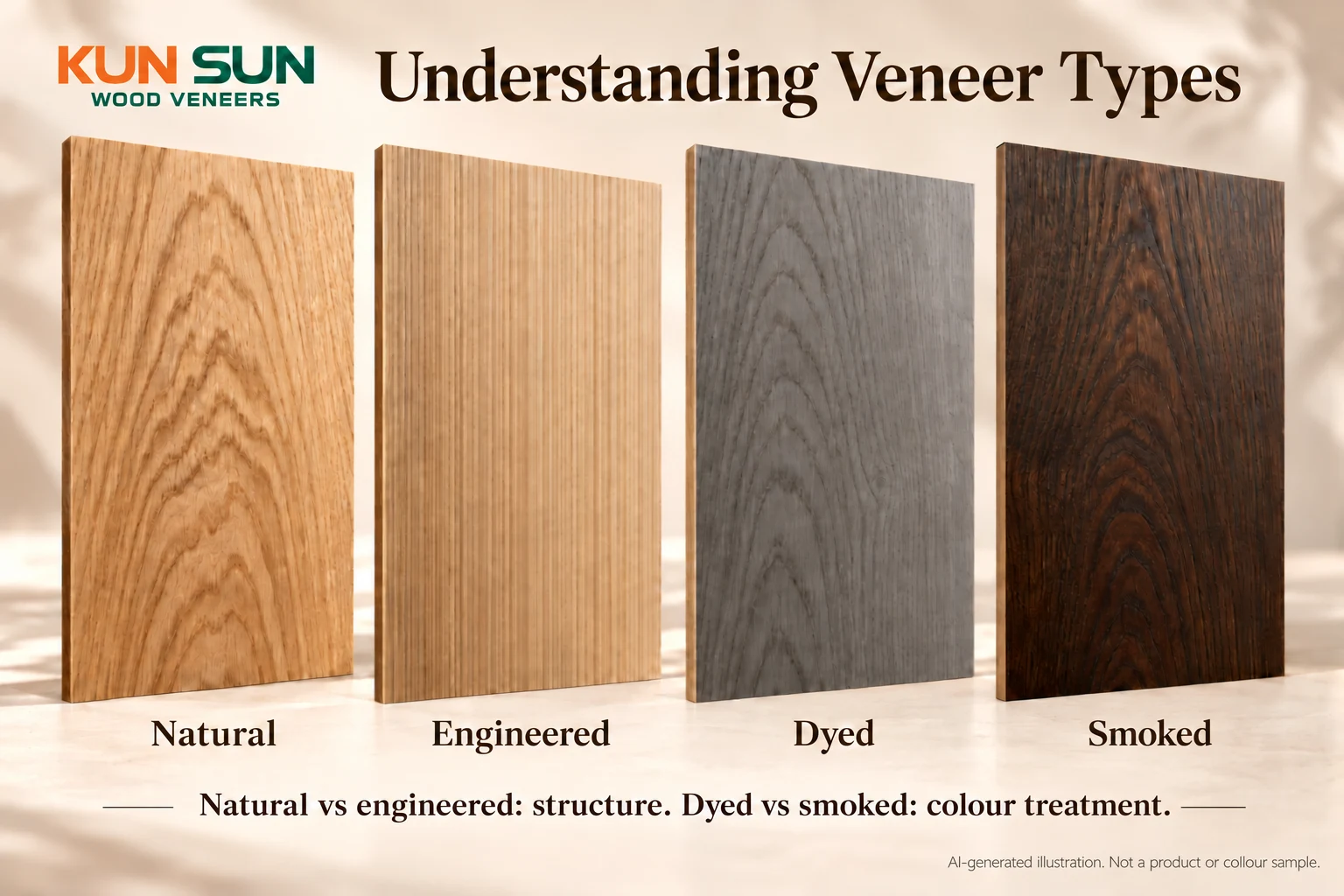
The four names describe two different questions. Natural versus engineered veneer describes how the wood grain is formed. Dyed versus smoked describes how colour is changed. A natural veneer can therefore also be dyed or smoked. The categories are useful, but they do not form four mutually exclusive material families.
Natural veneer: grain from the tree
Natural veneer is cut or peeled from logs or flitches into thin sheets. Its figure comes from the tree, while the cutting method changes its appearance. Plain slicing, quarter slicing and rotary cutting can produce different grain patterns from wood of the same species. Cutting methods: Columbia Forest Products
Variation in grain, tone, rays, knots, sapwood and heartwood may all be visible. “Natural” does not mean no processing. Ask whether the material was subsequently dyed or otherwise treated.
How to check: Examine several consecutive leaves from the same lot, then confirm the species, cut and supplier description. Matching or sequencing natural leaves can create regular patterns, so regularity alone is not proof of reconstitution.
Engineered veneer: a designed grain
Engineered veneer (also called reconstituted veneer) is made from real wood sheets. In a typical process, the sheets are dyed, assembled, glued and pressed into a new block, then sliced again. This allows the maker to design colour and grain. Production process: ALPI
It is a wood product rather than printed paper or plastic film. Yet an appearance name such as “ebony look” does not establish that ebony was used as the raw material.
How to check: Compare pattern repetition across leaves and request the raw wood species and process description. A repeated figure is a clue, but the specification is decisive.
Dyed veneer: colour is changed
Here “dyed veneer” mainly means natural veneer treated with dye while retaining the original grain. Dye can help achieve a coordinated palette or colours such as grey and blue. Engineered veneers may also use dyed wood sheets in their production. Process reference: Furniture Finishing and Coating training manual, p. 81
How to check: A vivid or unusually uniform colour is only a visual clue. Confirm the underlying species, treatment and depth of colour penetration. Do not assume every dyed veneer is dyed all the way through.
Smoked veneer: colour from a treatment reaction
A common method used for smoked veneer is fuming, which exposes tannin-bearing wood to ammonia, producing a darker colour through a chemical reaction. The result varies with species, the amount and distribution of tannins, and processing conditions. Process reference: IFN interior veneer guide
“Smoked” should not automatically be read as burning or charring. Suppliers may also use these words loosely for an appearance. Ask whether the actual process was ammonia fuming, heat treatment or dyeing.
How to check: A dark brown or grey-brown colour cannot identify the process by itself. Naturally dark, dyed and fumed veneers can look similar.
At a glance
| Name | Main question | Grain source | What to confirm |
|---|---|---|---|
| Natural | Is the original wood structure retained? | The tree itself | Species, cut and later colour treatment |
| Engineered | Were wood sheets reassembled? | Designed through layup and slicing | Raw species, process and production lot |
| Dyed | Was dye used to change colour? | Here, the original natural grain remains | Dye method, penetration and finishing compatibility |
| Smoked | What treatment changed the colour? | Commonly the original natural grain | Ammonia or another process; lot variation |
Four checks before ordering
- Specify the full material name. Record the raw species, whether it is natural or reconstituted, and any colour treatment. A colour name alone is insufficient.
- Review several leaves from the same lot. Check grain, colour range and matching. For large projects, agree how later orders will be handled.
- Approve a finished sample. Substrate, adhesive, sanding and coating all affect the final result. View the sample under the lighting planned for the project.
- Request product-specific evidence. Material names alone do not prove emissions, light resistance or durability. Check the actual veneer, substrate, adhesive, finish and applicable test documents.
Wood colours can change with light and age. Dyeing or smoking does not guarantee a permanent colour; engineered veneer cannot be promised to match absolutely across production lots. Agree the physical sample and technical requirements with the supplier. Technical reference: ALPI
First identify the veneer structure, then the colour treatment, and finally approve the finished sample.
The image is an AI-generated process illustration, not an actual KUNSUN product, stock item or approved colour sample.
Need to discuss veneer samples and specifications?
Contact KUNSUN VENEER →