Export Product Certification: Market Access and Shipping Checklist
Start with use, materials, functions and destination to establish obligations before production and shipment.
Statutory marking, certification, testing and transport documents serve different purposes; not every item applies to every product.
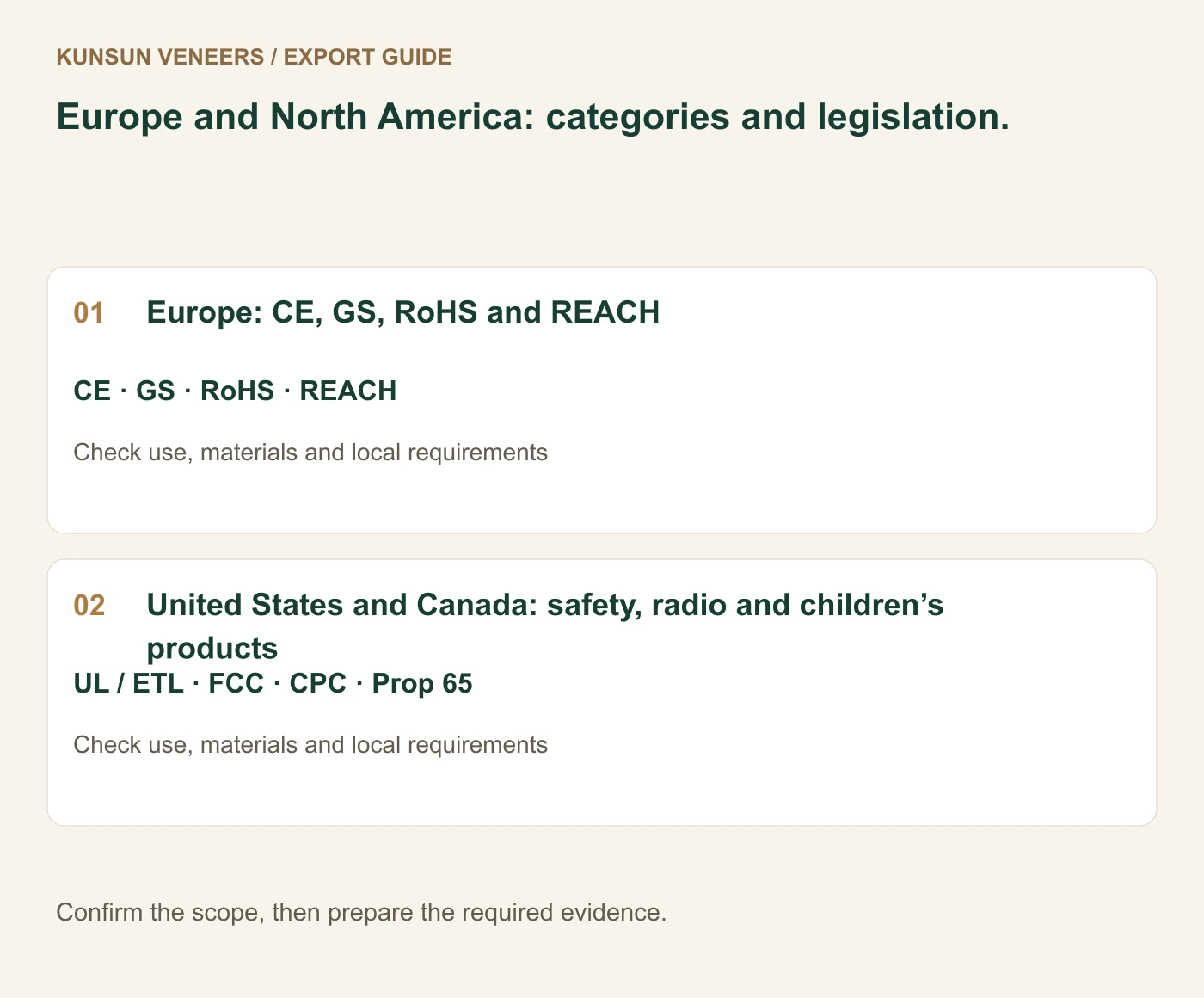
Europe: CE, GS, RoHS and REACH
CE applies only to categories covered by relevant EU legislation. Identify applicable rules, complete the prescribed conformity assessment, retain technical documentation and issue the required EU declaration. Not all routes require a notified body; out-of-scope products must not carry CE. GS is a voluntary German safety mark. RoHS concerns restricted substances in in-scope electrical/electronic equipment. REACH duties depend on substances, concentration, use and supply-chain role. A generic report is not permanent proof of every obligation. Toy standards, food contact, vehicles and energy rules require separate assessment; IP is a test classification, and an EU representative is not a certificate. [1][2]
Action:
United States and Canada: safety, radio and children’s products
UL and ETL are third-party safety certification systems, not universal certificates for every import. Check regulations, workplace rules, procurement and sales-channel requirements, and Canadian acceptance separately. FCC authorization concerns applicable radio-frequency equipment: confirm route, FCC ID, antennas, modules and labeling. Canada has separate ISED requirements. For regulated children’s goods made overseas, the US importer generally issues the CPC using passing CPSC-accepted laboratory results; a report alone is not a CPC. Check current eFiling and possible GCC duties. Proposition 65 concerns chemical exposure warnings and exemptions, not a universal pass/fail certificate. FDA, EPA and energy rules are category-specific. [3][4]
Action:
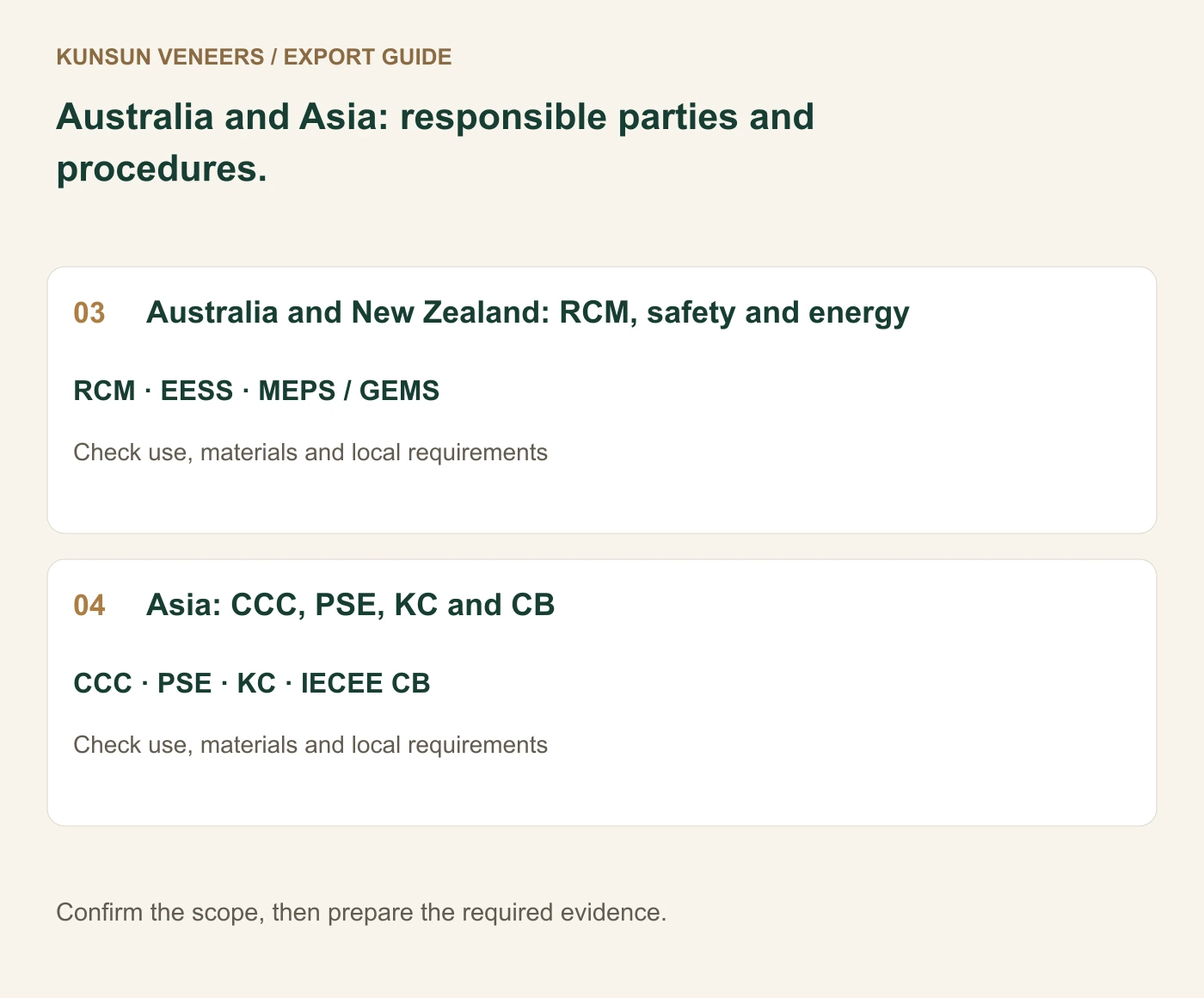
Australia and New Zealand: RCM, safety and energy
For EESS in-scope electrical equipment, establish risk level, local Responsible Supplier, registration and required evidence. The supplier must be a qualifying Australian or New Zealand entity. Review applicable ACMA EMC/radio duties as well. “SAA certification” does not mean every product needs one named body’s certificate. MEPS/GEMS concerns prescribed energy-using categories, with applicable registration and labeling. C-Tick is historical. Check Australia and New Zealand separately. [5] [13]
Action:
Asia: CCC, PSE, KC and CB
China CCC applies to its compulsory catalogue and implementation rules; domestic-market duties differ from destination import rules. Voluntary CQC is not a blanket replacement. Japan PSE covers designated electrical appliances/materials; classification determines assessment, third-party involvement, labeling and importer duties. Radio functions require separate review. Korea KC covers several systems, including electrical safety and radio/EMC; identify the specific scheme. IECEE CB supports recognition of electrotechnical tests and national certification applications, subject to local differences. It is not a worldwide import permit. An institution name such as TELEC is not a universal Asian certificate. [6] [11][12][15]
Action:
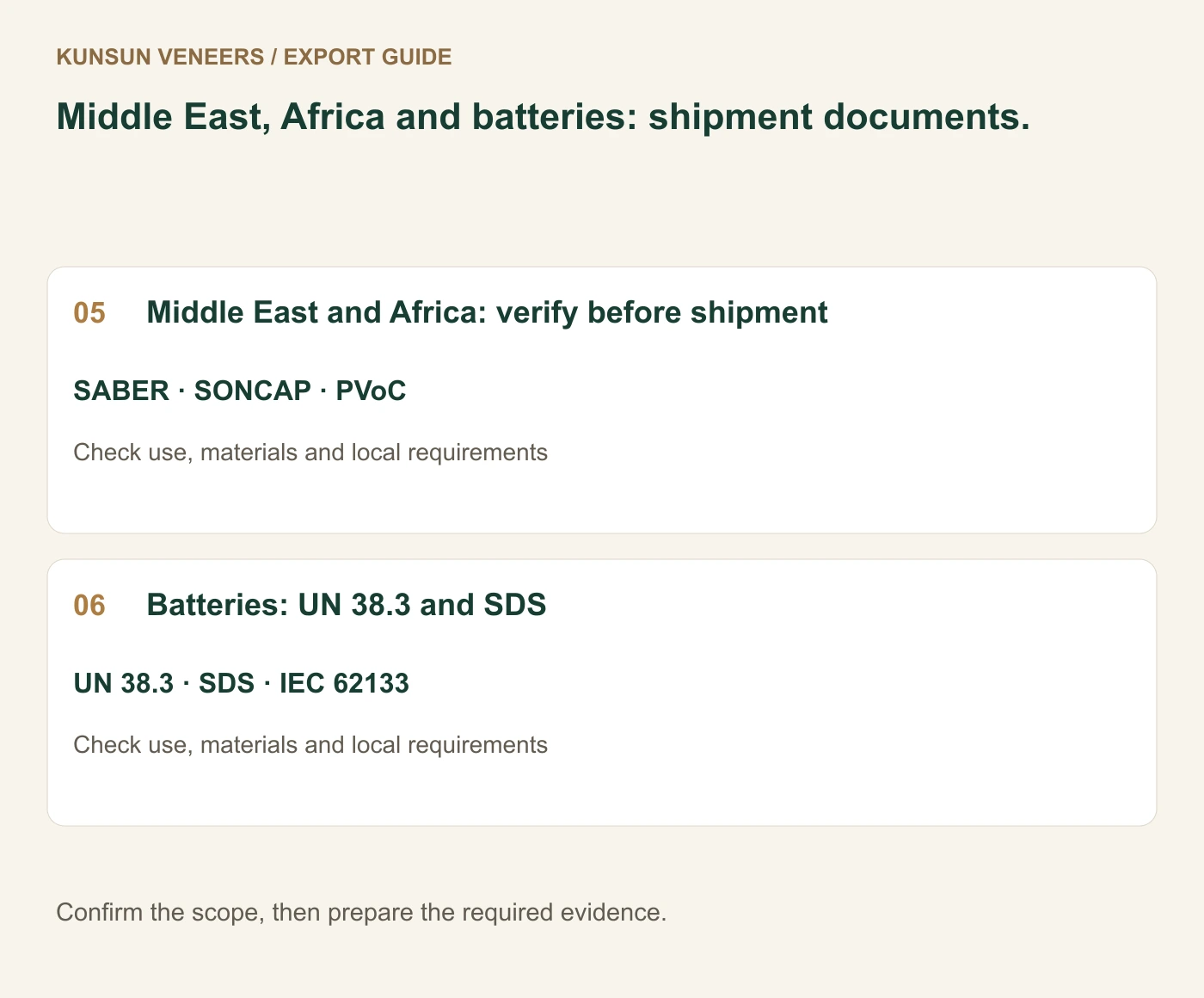
Middle East and Africa: verify before shipment
Saudi SABER is a product and conformity-document platform. Identify HS classification and technical regulations, then confirm product and consignment certificate requirements. Nigeria SONCAP and Kenya PVoC have separate controlled scopes, exemptions, routes and recognized providers. Product approval and shipment documents differ. Never assume cross-country validity or that missing papers can always be obtained after arrival. For Algeria, Egypt, Iran and other destinations, verify importer eligibility, registration, inspection and documentary requirements individually; COC, COI and VOC abbreviations alone do not establish a legal procedure. [7][8][9]
Action:
Batteries: UN 38.3 and SDS
Assess chemistry, watt-hours or lithium content, shipping configuration and transport mode. Check applicable UN 38.3 tests and test summaries, packaging, short-circuit protection, labels and declarations separately. Damaged, defective or recalled batteries face additional restrictions. SDS, often called MSDS, communicates safety information and does not replace test evidence or dangerous-goods documents. IEC 62133 product safety assessment does not automatically fulfill transport duties. The unclear “M4SL3” in the supplied reference is not recommended as a certification item. [10]
Action:
Reliability tests: specify conditions
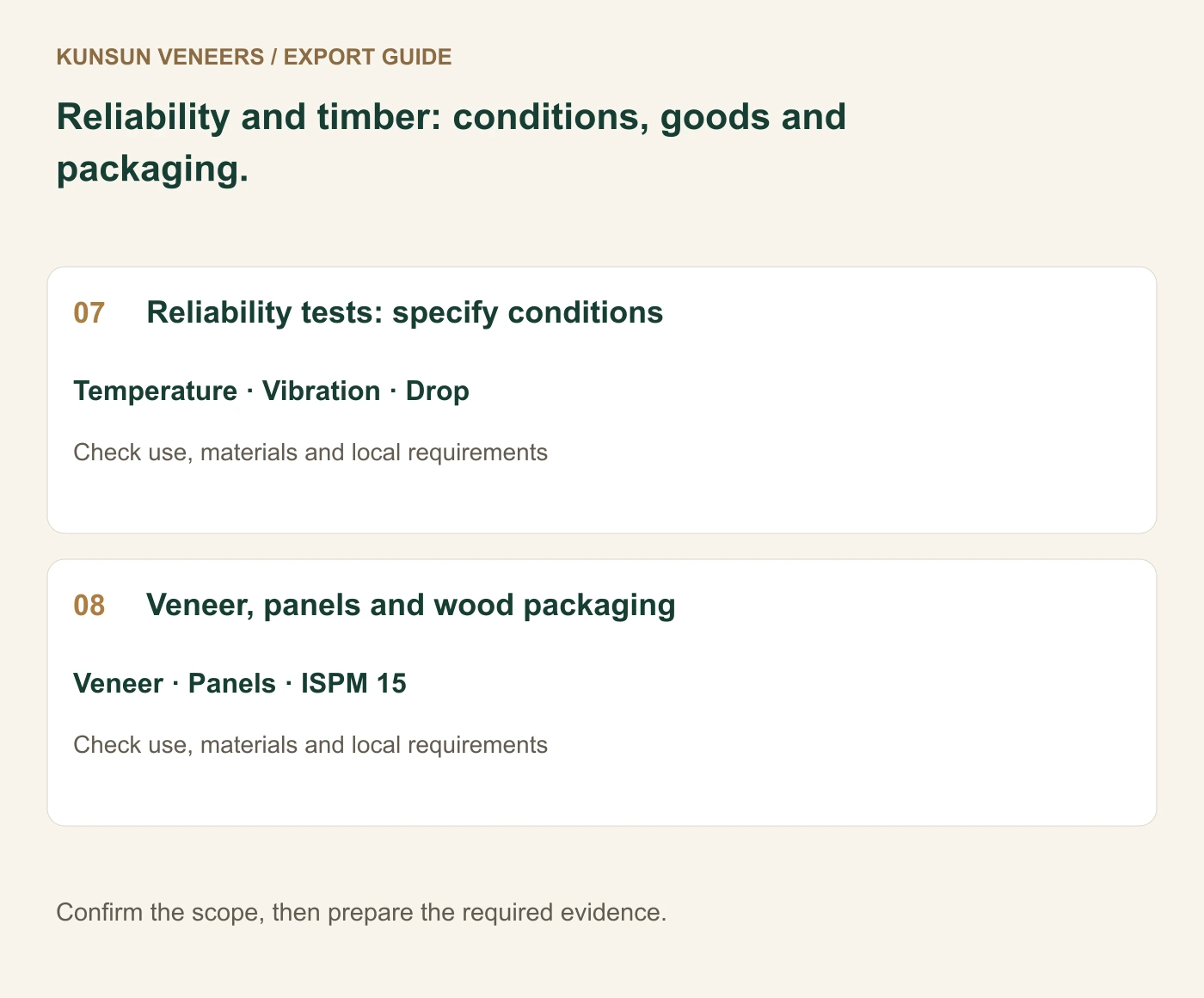
Temperature, humidity, salt spray, vibration, drop and impact tests assess particular stresses. Agree standard edition, sample/packaging state, temperature, duration, drop height/direction and acceptance criteria. A salt-spray result without conditions does not establish service life in every environment. Reliability reports generally do not replace market-access assessments.
Action:
Veneer, panels and wood packaging
Do not automatically apply electrical CE, RoHS or FCC checklists to ordinary veneer. Identify material, use, species, origin, processing and destination; review phytosanitary, legal-source, chemical and due-diligence obligations. Composite wood may require formaldehyde assessment; construction-use products need their own regulatory review. Check ISPM 15 applicability for solid-wood pallets, crates and dunnage. Packaging treatment marks, phytosanitary documents and product conformity evidence are distinct; an IPPC pallet mark does not certify the whole shipment. [14]
Action:
Four kinds of evidence
Identify the obligation before preparing evidence; these are not interchangeable.
| Test report | Results under defined conditions |
|---|---|
| Declaration | Issued by the responsible party |
| Certification | Assessment under the applicable scheme |
| Shipment documents | According to goods, mode and consignment |
Six checks before shipping
- Document model, BOM, use, labels and instructions.
- Confirm destination, channel, HS code and importer.
- List legislation, standards, registration and documents.
- Check laboratory recognition and model coverage.
- Assess before production and booking; review changes.
- Reconcile invoice, packing list, certificates, label languages and transport papers; retain records.
Frequently asked questions
Does every EU import need CE?
No. Only categories covered by relevant legislation.
Does SDS replace UN 38.3?
No. They serve different purposes.
Official references
- European Commission — CE
- ECHA — REACH
- CPSC — CPC
- OEHHA — Proposition 65
- EESS — Compliance
- METI — PSE
- SASO — SABER
- SON — SONCAP
- KEBS — PVoC
- PHMSA — Lithium batteries
- CNCA — Compulsory certification rules
- KATS — Electrical safety
- Energy Rating — Registration
- IPPC — ISPM 15
- JQA — IECEE CB Scheme
Updated 2026-10-29. Verify current requirements for the actual product. Original graphics do not claim KUNSUN certifications or certification services.