
PRODUCT KNOWLEDGE · BLACK WALNUT
How to Identify North American Black Walnut Lumber Grades
Black walnut quotations often mention FAS, F1F, No.1 Common and SUP. Start by separating lumber yield grading from appearance sorting for colour, knots and grain. A photograph, dark colour or attractive cathedral grain cannot establish an FAS grade.
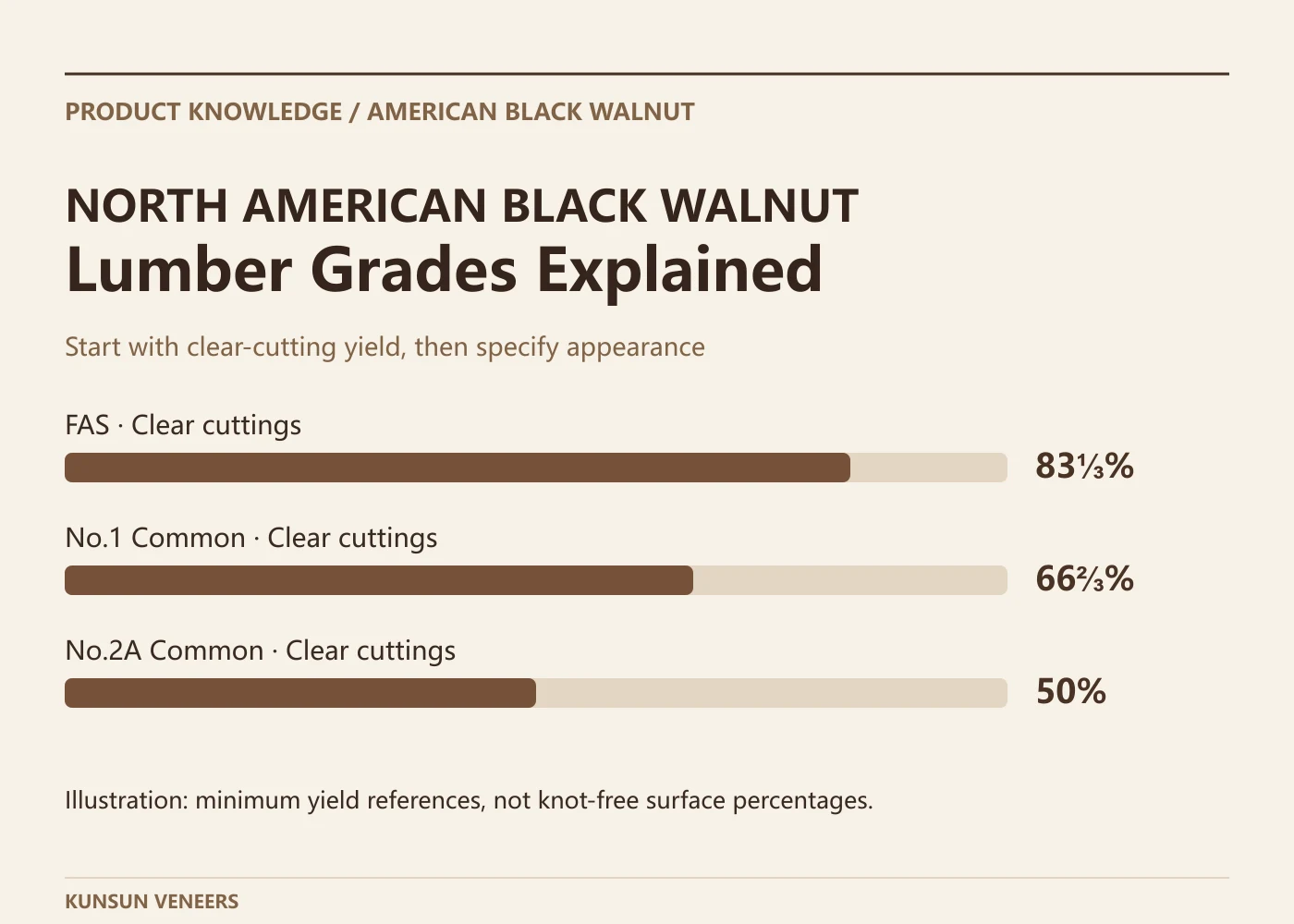
1. What does FAS actually mean?
FAS stands for Firsts and Seconds. NHLA lumber grading evaluates recoverable cuttings under defined rules; it does not simply add up visibly knot-free areas. It does not certify finished-furniture quality, strength, density or colour matching.
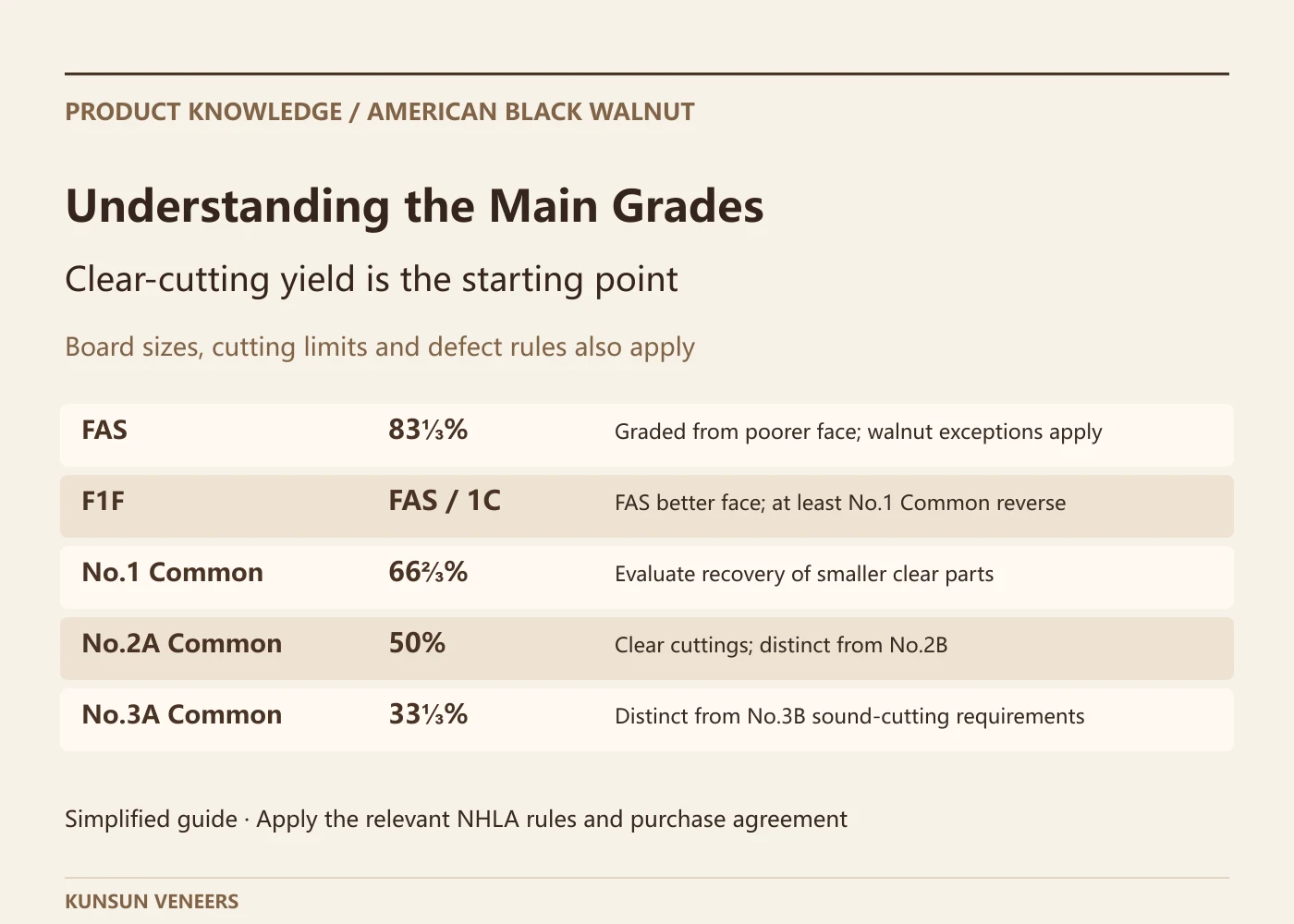
2. Compare the main grades
The table gives simplified clear-cutting yield references. Board size, cutting dimensions, cutting counts and defect limitations also matter. F1F means FAS One Face: the better face meets FAS and the reverse meets at least No.1 Common. It does not promise identical appearance on both sides.
| Grade | Clear-cutting yield reference | Key distinction |
|---|---|---|
| FAS | From 83⅓% | Normally graded from the poorer face; walnut exceptions apply |
| F1F / FAS One Face | FAS better face; at least 1C reverse | A face-grade combination, not one yield percentage |
| No.1 Common | From 66⅔% | Evaluate recovery of smaller clear parts |
| No.2A Common | From 50% | Clear cuttings; distinct from No.2B |
| No.3A Common | From 33⅓% | Distinct from No.3B sound-cutting requirements |
3. Apply the walnut exceptions
Walnut FAS has specific provisions for dimensions, cuttings and sapwood. Listed minimum rough-board dimensions are 5 inches wide and 6 feet long; 6–7-foot boards have additional grading provisions, and kiln-dried dimensions involve applicable allowances. State the rulebook edition, drying condition and supplier exceptions in the order. Have the full requirements checked rather than relying on a generic size threshold.
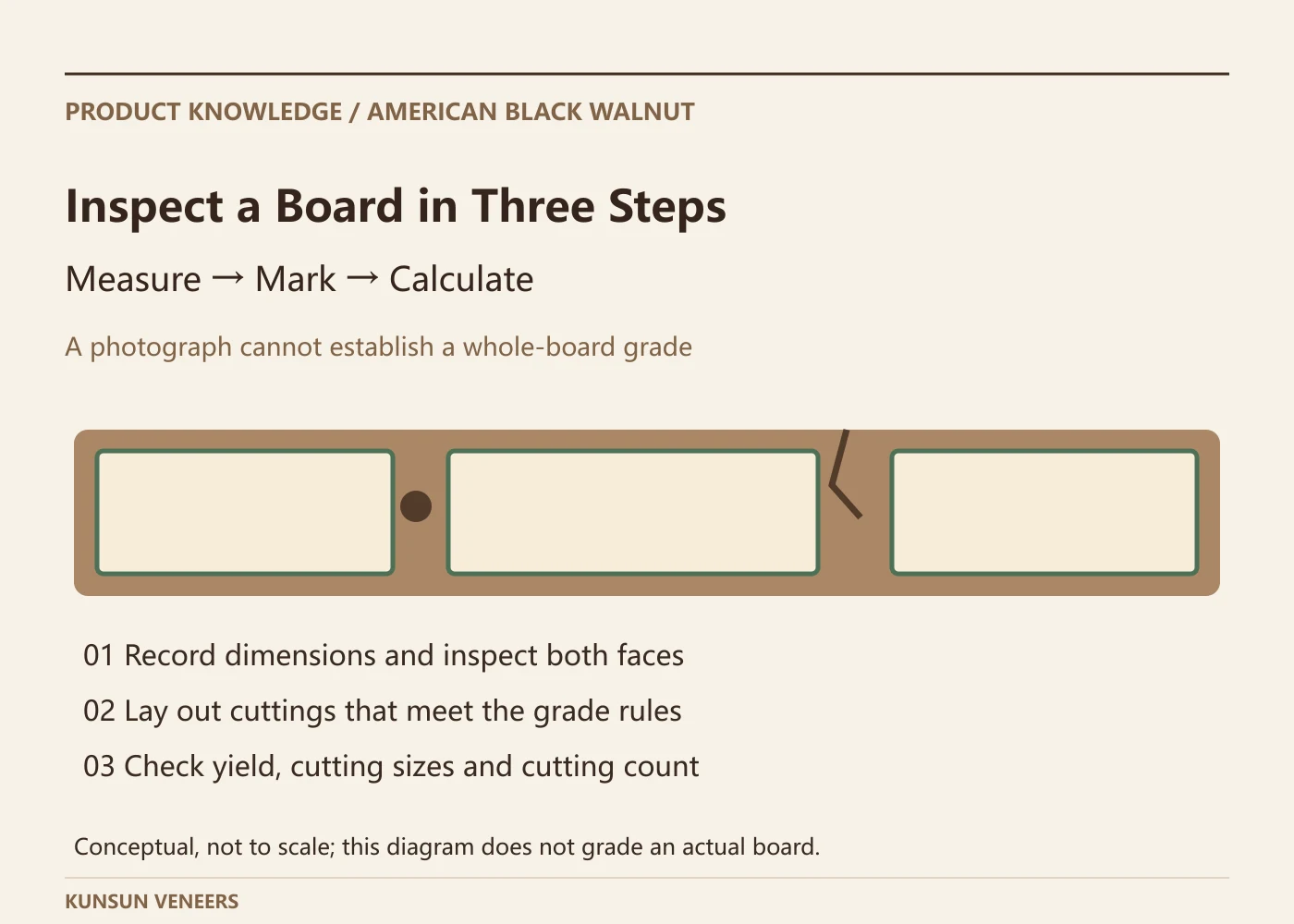
4. Inspect the actual boards
Confirm species, agreed grade and measurement basis. Measure each sampled board and inspect both faces, recording knots, holes, checks, decay and wane. Lay out qualifying cuttings and check recovery, minimum cutting sizes and cutting counts against the applicable rules. A close-up of one face or a low knot count is insufficient. Test colour, sapwood, moisture and warp against separately agreed acceptance criteria.
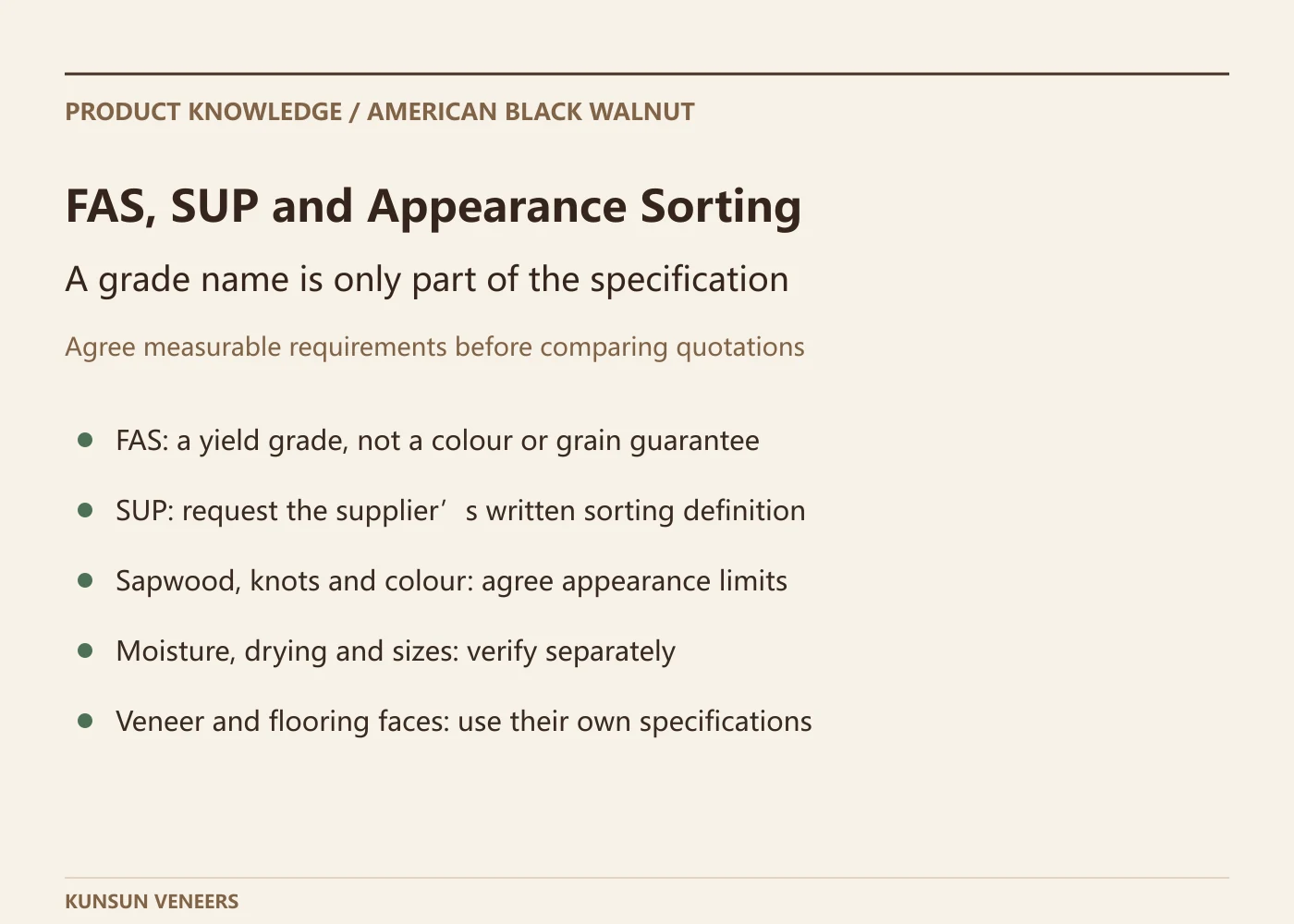
5. What does SUP mean?
Do not assume SUP or Superior denotes a uniform NHLA grade. A supplier may use it for a proprietary sorting programme. Request a written definition covering the underlying grade, sapwood, knots, colour variation and size selection. Without a shared specification, it cannot be assumed superior to every FAS parcel or assigned a fixed price premium.
6. Match the grade to the parts
Projects requiring long, wide clear pieces should compare the recovery of upper grades. Smaller parts may justify evaluating Common grades against the cutting list. Suitable clear pieces recovered from a lower-grade board can serve furniture applications. Veneer, veneered-panel and flooring-face appearance labels such as AAA or AB cannot be converted directly into NHLA FAS lumber grades.
Put these details in the purchase order
- Species: American black walnut (Juglans nigra), supported by supplier records
- Grade, rulebook edition and any FAS/F1F or other grade mixture
- Thickness, width/length range, rough/surfaced condition and tally basis
- Finished-part sizes, appearance limits, heartwood/sapwood and reference samples
- Moisture target, sampling plan, warp and checking limits
- Written definitions of SUP or other trade names and dispute procedures
Frequently asked questions
Does dark colour or cathedral grain prove FAS?
No. Colour and figure are appearance requirements, not substitutes for whole-board cutting evaluation.
Does FAS guarantee no knots or sapwood?
No. It does not mean an entirely knot-free, sapwood-free board. Apply the relevant cutting and feature rules, with additional appearance limits agreed separately.
Does FAS establish AAA veneer quality?
No. Lumber yield grades and veneer appearance specifications apply to different materials and requirements.
These original Kunsun diagrams are conceptual illustrations, not photographs of a graded parcel or third-party certification. Supplied reference images remain archived with their attribution intact; their photographs are not presented as Kunsun products.
References and verification
- NHLA grading rules
- NHLA 2023 rulebook — Walnut & Butternut
- AHEC — The Grades
- AHEC — Additional guidance
- NWH — Walnut FAS/1F supplier specification example
References checked 15 October 2026. This introduction does not replace the full grading rules.
Related reading
Discuss Your Black Walnut Selection
Share the application, finished-part dimensions, quantity and appearance samples to define selection and acceptance requirements.
Contact Kunsun Veneer