
Common Wood Veneer Matching Methods: A Practical Guide
The same veneer can look very different when leaf order, face orientation and grain direction change. Decide whether the surface should repeat, mirror or vary naturally before agreeing on fabrication.
Leaf matching, panel layout and matching across panels are separate requirements. Informal trade names are not universal specifications. Use drawings and finished samples. Photographs illustrate appearance; they do not prove a species or fabrication sequence.
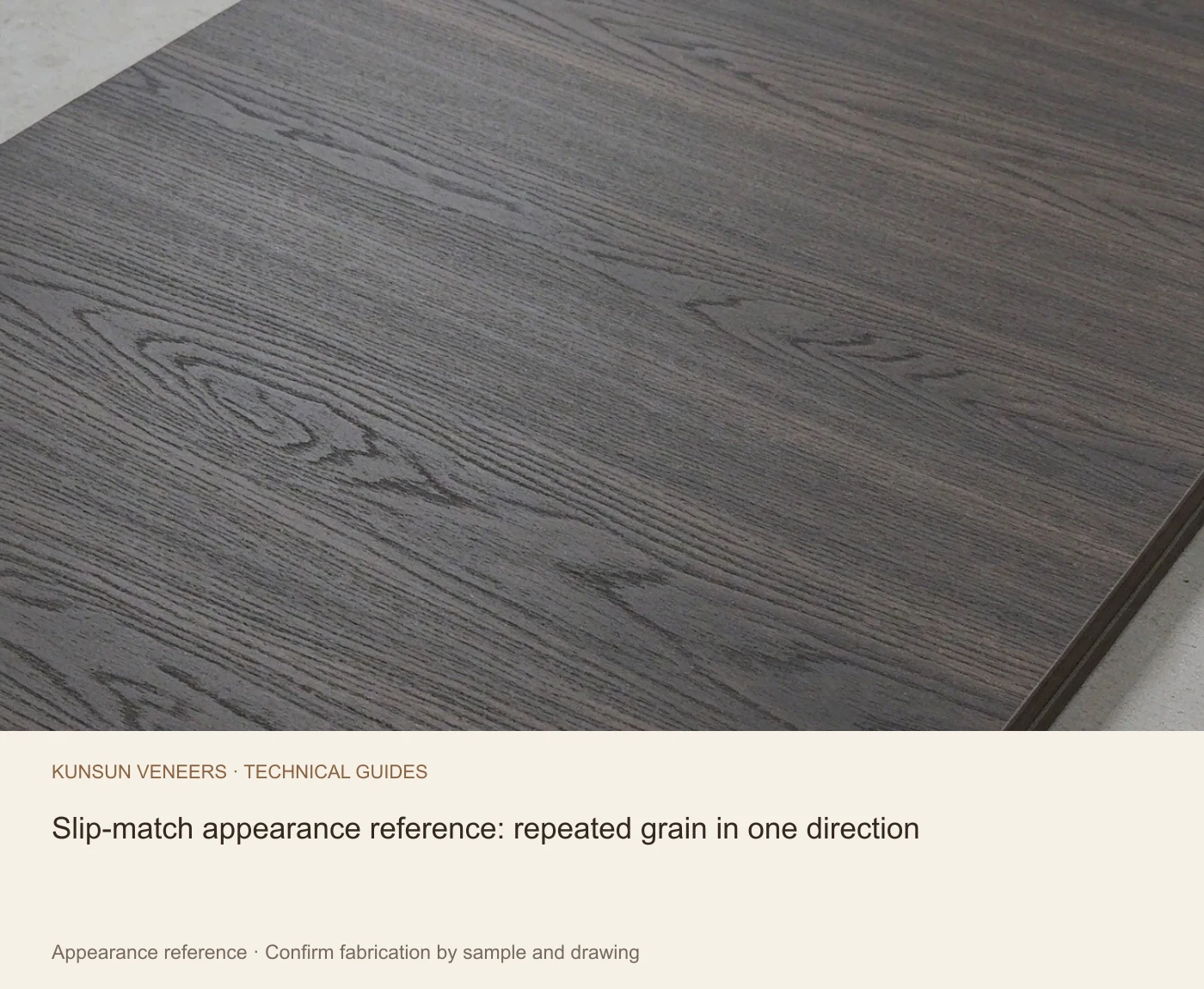
Slip match
Successive leaves from a flitch are moved sideways in sequence with the same face and orientation exposed, rather than alternately mirrored. The figure repeats rhythmically. Straight grain often gives a calm result, but slip matching can also use crown grain.[1]
Use and specify:Cabinet fronts and wall panels; agree leaf widths and panel sequence.
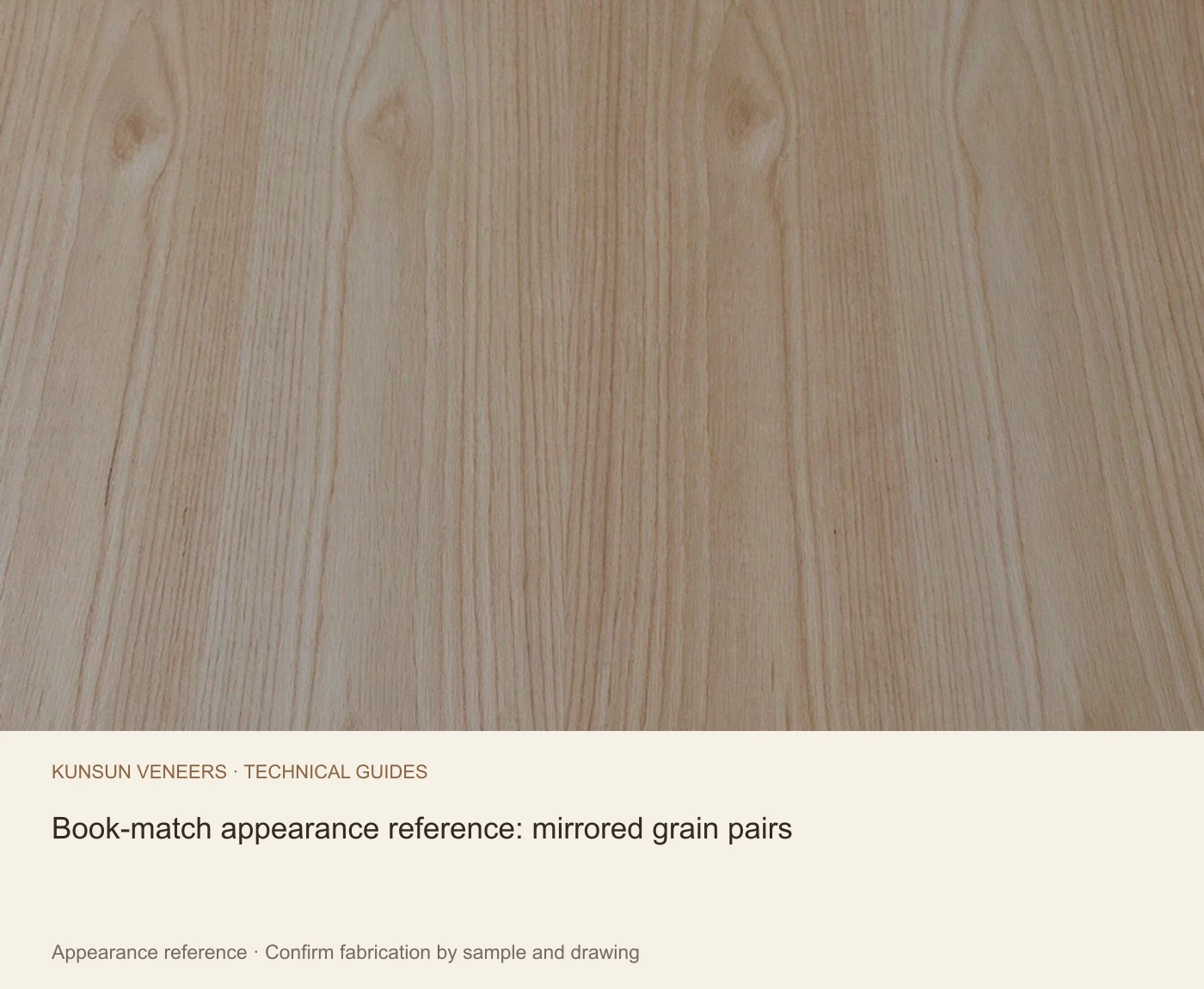
Book match
Alternate consecutive leaves are turned like book pages to create mirrored pairs. Crown figure can form arches or diamond-like shapes, but diamonds are not guaranteed. Alternating faces can reflect light differently and create a barber-pole effect. Assess the final finish under project lighting.[1]
Use and specify:Symmetrical doors, furniture and feature walls; define the centerline and mirror direction.
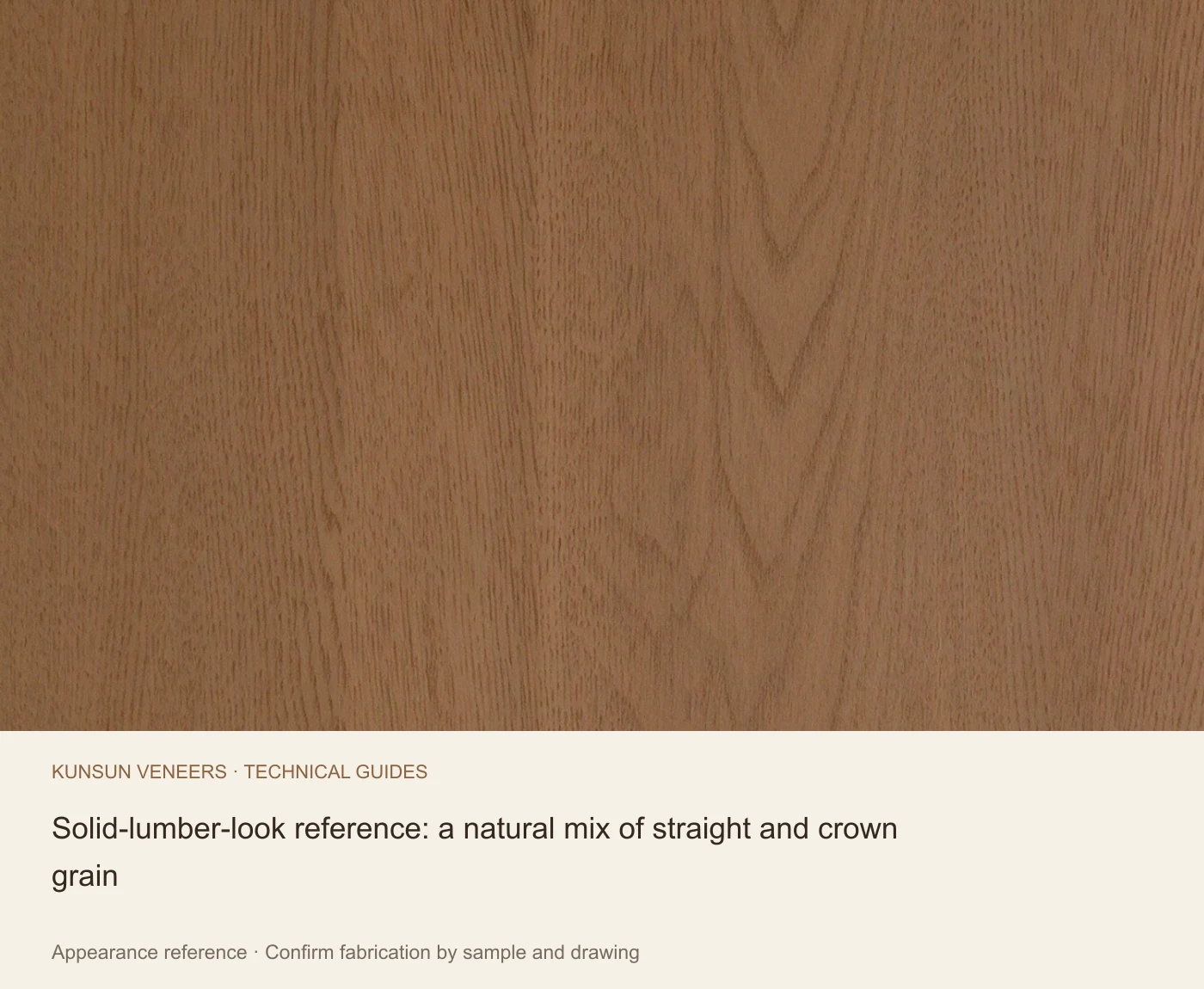
Random match
Leaves are arranged without aiming for sequential repetition or mirror symmetry. Grain, widths and tones can be selected for a natural mix, including straight and crown figure. This can suggest solid lumber boards, but the surface remains veneer.[2]
Use and specify:Natural-looking furniture and walls; approve an entire panel and the allowed variation.
End match
Leaves are joined along their length to extend a design or cover a longer panel. End reversal or mirror arrangements must be defined by a drawing. Lengthwise joints remain part of the layout even when the overall figure appears continuous.[1]
Use and specify:Tall doors and long panels; show end-joint positions, orientation and continuity.
Decorative layouts: chevron, herringbone and four-way
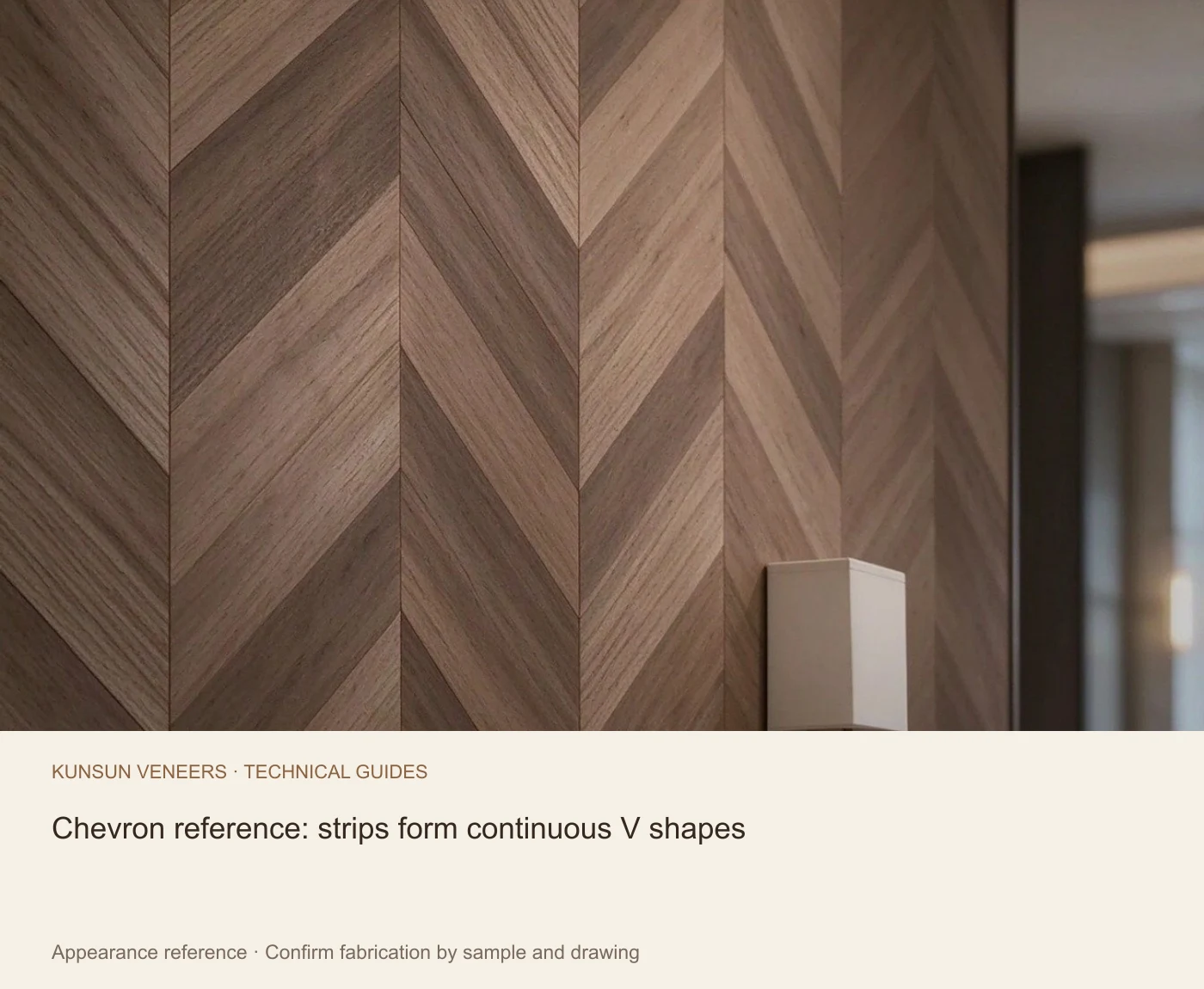
Chevron generally uses angled strip ends meeting along a centerline to make continuous V shapes. Herringbone generally interlocks rectangular strips in a staggered zigzag. Four-way arrangements combine mirrored units around a center. These describe geometry and should not be confused with ordinary book matching.
Use and specify:Feature walls and furniture focal points; confirm angles, module, centerline, borders and cutting allowance.
Cross-grain layouts and a solid-lumber look
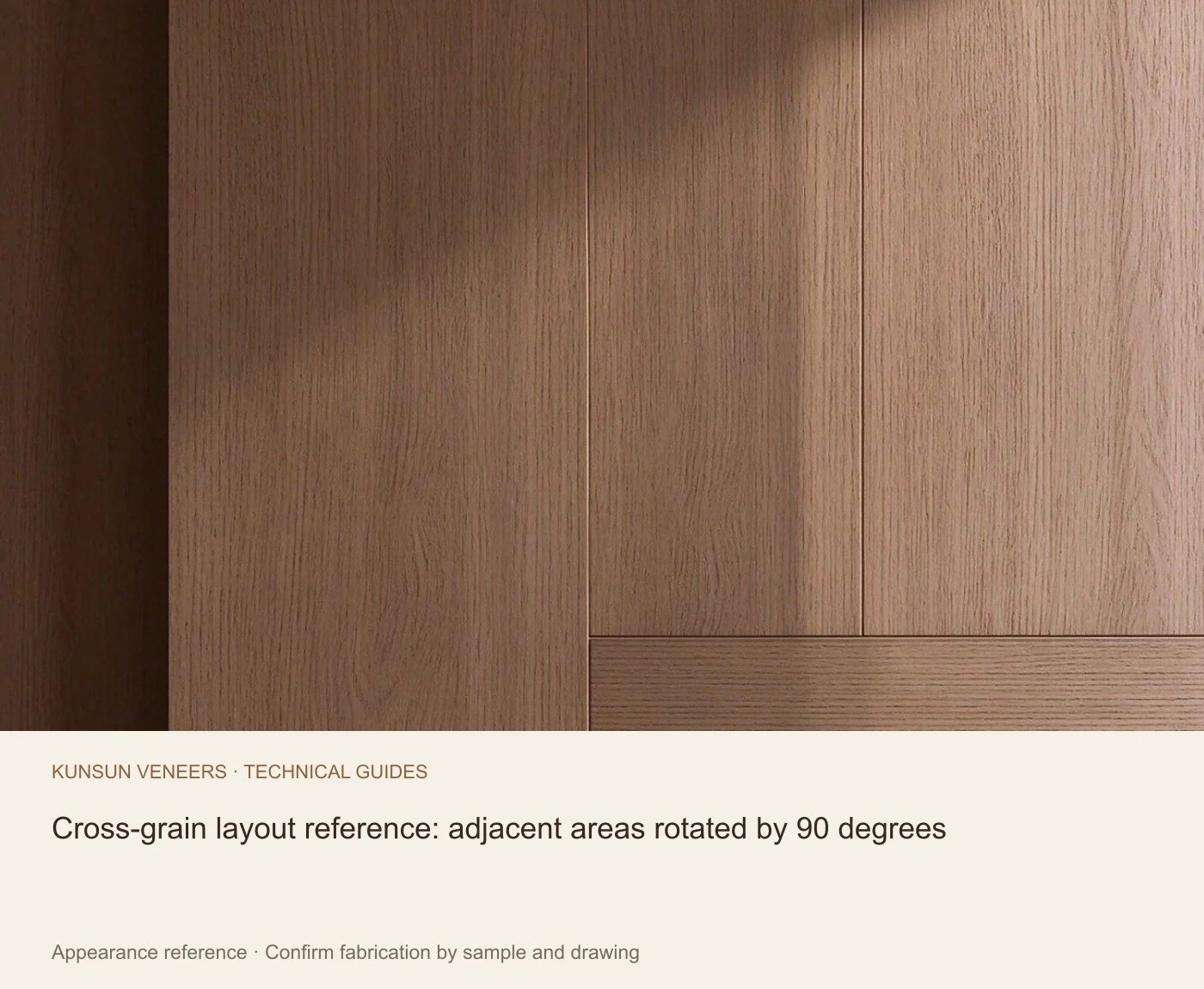
The supplied cross-grain example rotates the grain of adjacent areas by 90 degrees; that alone does not make it random matching. The V-shaped wall is not an illustration of irregular short pieces. A solid-lumber look describes a visual goal that can be achieved with mixed veneer.
Use and specify:Specify leaf matching, panel sizes, grain arrows, panel numbers and acceptable variation together.
How to choose
Choose symmetry, repetition or natural variation, then define panel and multi-panel layouts.
| Slip match | Cabinet fronts and wall panels; agree leaf widths and panel sequence. |
|---|---|
| Book match | Symmetrical doors, furniture and feature walls; define the centerline and mirror direction. |
| Random match | Natural-looking furniture and walls; approve an entire panel and the allowed variation. |
| End match | Tall doors and long panels; show end-joint positions, orientation and continuity. |
| Decorative layouts: chevron, herringbone and four-way | Feature walls and furniture focal points; confirm angles, module, centerline, borders and cutting allowance. |
Ordering and acceptance checklist
- Confirm species, cut, veneer thickness and panel core.
- Approve a large finished sample showing the full repeat and joint pattern.
- View it under the main lighting, raking light and normal viewing angles.
- Mark panel sequence, grain direction, centerlines and joints on shop drawings.
- Keep the signed sample; assess color, defects, glue lines and open joints separately.
Frequently asked questions
Is light-dark striping in book match always a defect?
No. Alternating faces can reflect light differently, but real color and finishing differences can also contribute. Compare with the approved sample and agreed criteria.
Can a photograph confirm the matching method?
It shows appearance, not proof of consecutive leaf sequence, face orientation, species or finishing. Confirm these with the fabricator.
References
User-supplied appearance references; original marks and text cropped out without reconstructing grain.