
Wood Moisture Content: Targets, Testing and Acceptance
What moisture content is right for solid wood? Start with the final service environment, product construction and installation requirements, then agree a target, test method and acceptance range. One percentage is not a universal Chinese, US or European standard, and drier is not automatically better.
First define what the percentage means
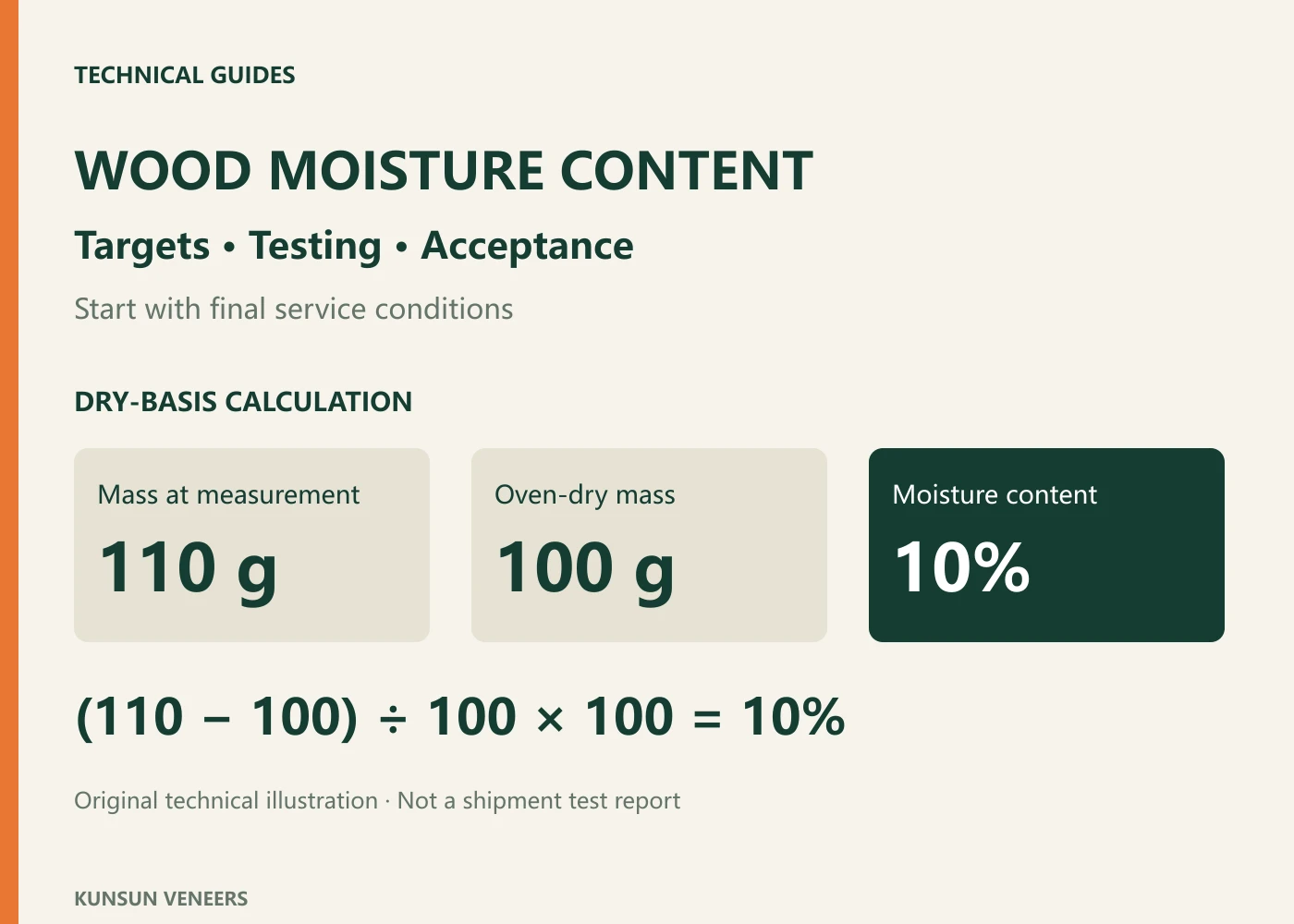
Wood moisture content normally uses an oven-dry basis: MC = (mass at measurement − oven-dry mass) ÷ oven-dry mass × 100%. A specimen weighing 110 g before drying and 100 g oven-dry has 10% MC, not the 9.1% obtained using 110 g as the denominator. Obtain the oven-dry mass using the applicable test method; air-dry mass is not a substitute. Meter readings additionally depend on calibration, species and measurement conditions.[1][3]
Set the target from service conditions
Wood gains or loses moisture in response to surrounding air. Under relatively stable temperature and relative humidity, it tends toward the corresponding equilibrium moisture content (EMC). Set a supply target using expected indoor conditions at the destination, seasonal variation and the intended application. Outdoor weather data do not necessarily describe the indoor service environment. Coatings slow moisture exchange but do not permanently prevent it.[1][2]
Read the equilibrium moisture reference correctly
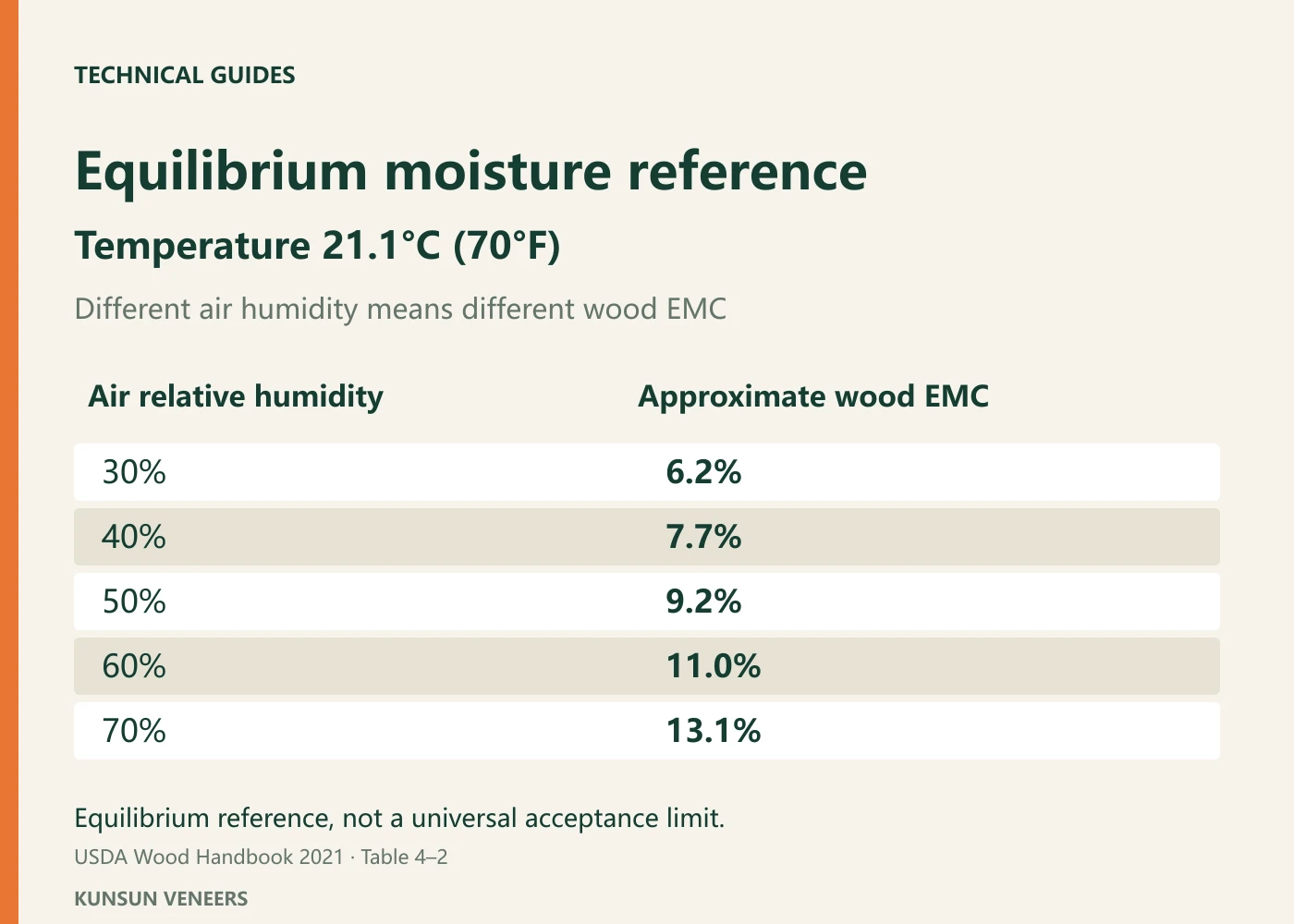
The table selects values at 21.1°C (70°F) from Table 4–2 of the 2021 USDA Wood Handbook, rounded to one decimal. It illustrates how higher air humidity generally raises wood EMC at the same temperature. These are equilibrium references, not instant delivery readings, contractual tolerances, national mandatory limits or a calibration table for every composite panel.[1]
| Air relative humidity | Approximate wood EMC |
|---|---|
| 30% | 6.2% |
| 40% | 7.7% |
| 50% | 9.2% |
| 60% | 11.0% |
| 70% | 13.1% |
At 21.1°C; USDA 2021, Table 4–2. Equilibrium reference only.
Furniture, flooring and veneer need different checks
For furniture and interior joinery, use the final room conditions and dimensional requirements. Solid flooring also requires assessment of the subfloor, site and installation system, following the specific manufacturer’s instructions; “all flooring must be 5–8%” is not a universal rule. Veneer, thick veneer and veneered panels require attention to thickness, backing and adhesive layers. A meter unsuitable for that thickness or construction cannot simply provide acceptance measurements. Structural or exterior timber requires its applicable design, exposure, treatment and project standards.[2][3][4]
Match the measurement method to the question
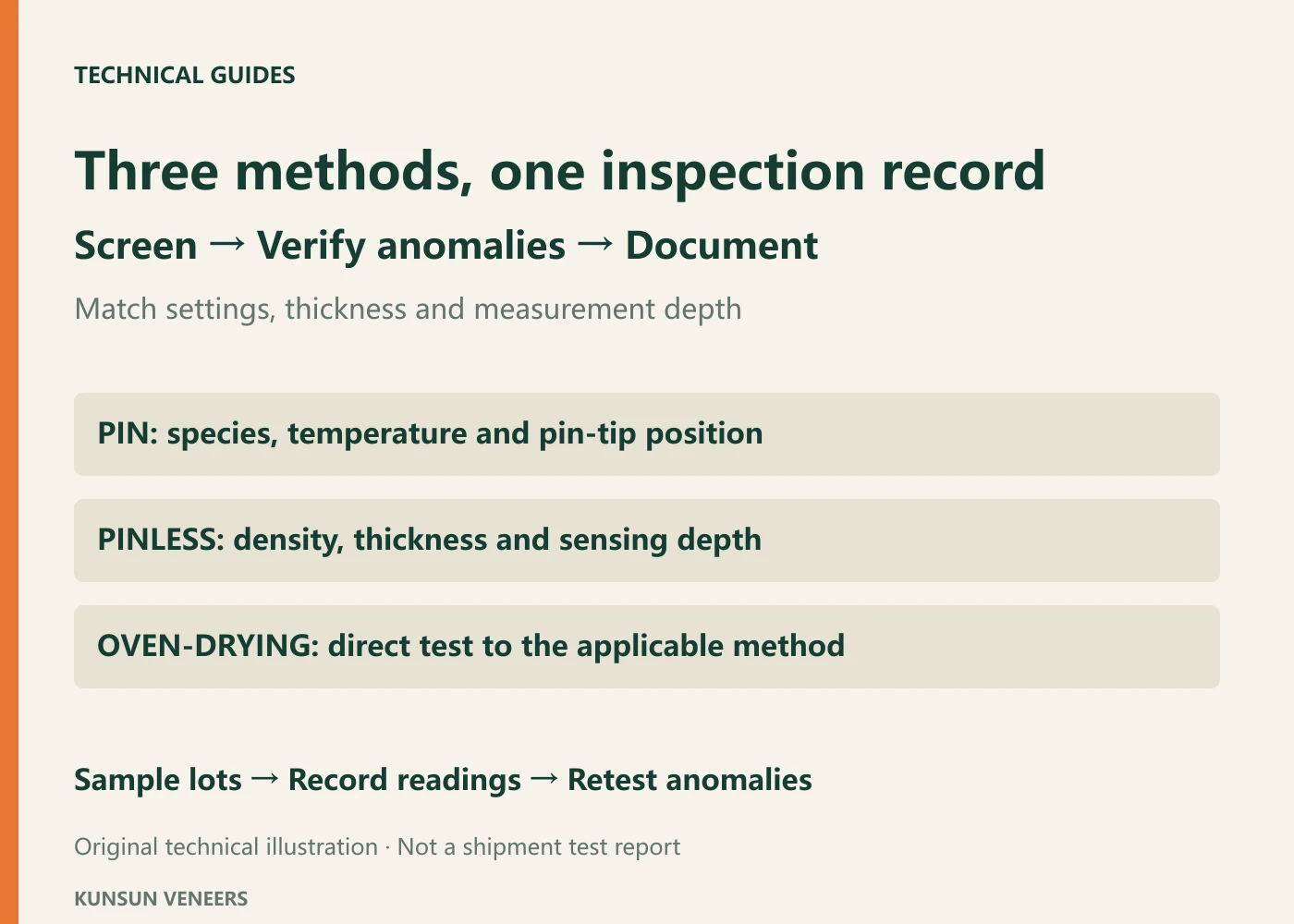
Pin meters generally measure electrical resistance and require species and temperature corrections as instructed. Pin-tip position and insulation affect the meaning of depth readings. Pinless meters enable rapid scanning, but species or density settings, specified thickness, contact and sensing depth matter. Metal, backing, adhesive or surface conditions may affect readings. Oven-drying determines mass change directly and can support verification or dispute testing, but sampling is destructive. ASTM D4442 covers direct methods; Method A is the primary oven-drying method. A portable meter is not automatically a correction-free laboratory result.[2][3][4] [5]
| Method | Use | Checks |
|---|---|---|
| Pin meter | Local / pin-tip depth checks | Check species, temperature correction and pin type; leaves holes |
| Pinless meter | Rapid scanning and screening | Check density setting, thickness, sensing depth and contact |
| Oven-drying | Direct determination and verification | Destructive sampling; apply the relevant standard and material conditions |
Inspect the distribution, not just an average
Separate lots by species, thickness, drying batch and packaging. Follow an agreed sampling plan spanning different packs and positions. Record date, ambient temperature/RH, meter model, settings and measurement locations; avoid or identify interfering features. Where needed, investigate surface-to-core differences instead of testing only accessible faces. Retain individual readings, minima, maxima and the distribution, and isolate anomalous boards for retesting. A passing average can hide wet boards, local moisture or gradients.[2][4]
Drying, transport and conditioning take evidence
Kiln schedules must suit species, thickness and initial condition. A target average alone does not establish freedom from internal checks, drying stress, warp or significant gradients. Dried wood can regain moisture in transit or storage. Protect it from rain, ground moisture and condensation, and arrange stacking and airflow to suit the process. Decide conditioning time using actual service conditions, dimensions and repeated measurements; a fixed number of days is not proof of readiness.[1][2]
Write acceptance rules into the purchase order
Agree the target and range, who measures, the sampling plan, depth, timing and dispute procedure. Batch average, individual-board limits and permitted out-of-range proportions are different criteria and should be specified separately. Conformance at dispatch does not guarantee an unchanged MC in every destination climate. Moisture requirements complement dimensions, appearance, warp, checks and machining allowance; they do not replace those criteria.
Purchase and inspection record template
- Species, construction, thickness, lot identification and intended use
- Expected service temperature/RH and actual inspection conditions
- MC target, range, individual limits and handling of exceptions
- Sample size, pack coverage, measurement locations and depth
- Meter model, species/density settings, temperature correction and checks
- Individual readings, retest results, dispute method and responsibilities
Frequently asked questions
Is 8–12% a universal furniture standard?
No. Some projects may specify that range, but suitability depends on service conditions, the product and the agreement. Identify the actual standard or project basis rather than calling it a nationwide rule.
Does lower MC always mean greater stability?
No. Over-dry wood can absorb moisture and swell in a more humid environment. Match the target to service conditions and control gradients and drying quality.
Does a 10% meter reading prove the core is also 10%?
No. The result relates to the device’s sensing area and settings. Surface-to-core gradients, measurement depth and construction affect interpretation.
Can a normal solid-wood meter accept thin veneer or veneered panels?
First confirm minimum thickness, backing and material suitability. Otherwise adhesive or underlying materials may influence readings. Validate a screening use or choose an appropriate method.
Technical sources
- USDA Wood Handbook 2021, Chapter 4: Moisture Relations and Physical Properties of Wood
- USDA Wood Handbook 2021, Chapter 13: Drying and Control of Moisture Content and Dimensional Changes
- ASTM D4442: Direct Moisture Content Measurement of Wood and Wood-Based Materials
- Oregon State University Extension, EM 8600: Wood Moisture Relationships
- Wagner Meters: Pin and Pinless Meter Differences (instrument-specific guidance)
Original technical illustrations, not test reports for a particular shipment. The regional fixed percentages in the reference webpage are not presented as universal standards.