
Engineered Flooring Top Layers: Thickness, Refinishing and Underfloor Heating
A flooring top layer is the real-wood face component of an engineered wood floor, often called a lamella. Specify thickness together with the finished construction, processing allowance, maintenance plan and heating requirements. Neither layer count nor a nominal millimetre figure guarantees service life, a fixed number of sandings or heating compatibility.
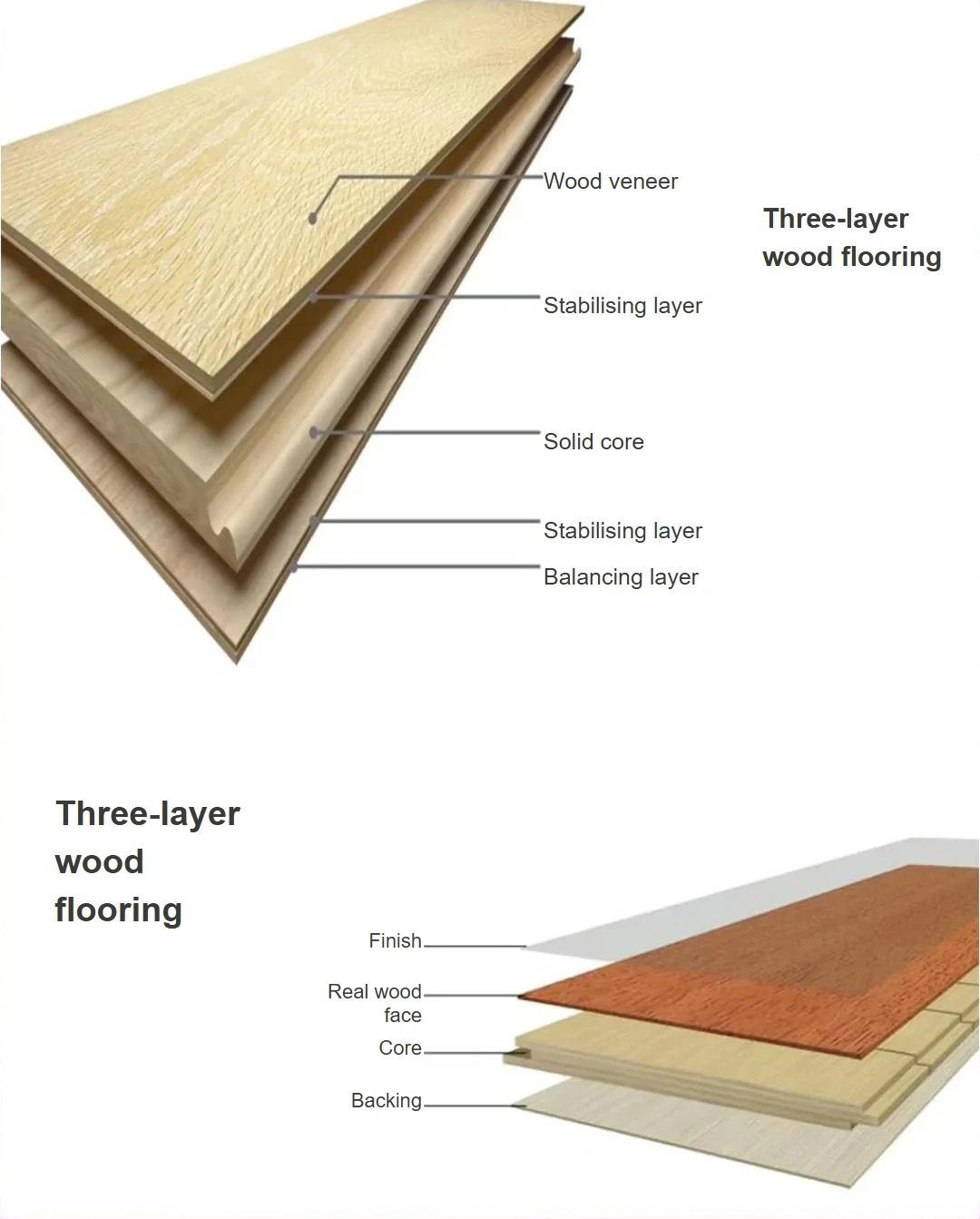
1. Three different thickness measurements
| Measurement | What is measured | Procurement meaning |
|---|---|---|
| Raw lamella thickness | Sawn or sliced face before bonding | Define tolerance, moisture condition and processing allowance |
| Finished wood-face thickness | Wood remaining after bonding, sanding and texturing, excluding finish | More relevant to the delivered floor than the raw nominal value |
| Remaining sanding allowance | Wood that may safely be removed from an existing floor | Limited by thin points, joint geometry, damage and flatness |
Overall floor thickness also includes the core and balancing layer. Finish is not extra wood allowance. A 15 mm board does not have a 15 mm face. A loose lamella is a component, not a validated finished flooring system.[1]
2. Three-layer versus multi-ply construction
Three-layer products commonly combine a face, core and balancing back. Multi-ply products may use a plywood platform. Cross-oriented layers help manage moisture movement, but performance depends on the full construction, bonding and environment. Multi-ply does not automatically mean unsandable, nor does three-layer automatically mean refinishable. Verify the particular floor and its remaining wood face.[1]
3. Thickness comparison for initial screening
This is a purchasing framework, not a standard, market-share classification or service-life rating. Processing losses and repair options can differ at the same nominal thickness.
| Nominal lamella thickness | Technical focus | Do not promise |
|---|---|---|
| 0.6–0.8 mm | Thin wood face; prioritise finish protection and approved maintenance | Sanding back to bare wood |
| 1.2–1.5 mm | Verify finished minimum thickness, finish and repair method | A universal optimum for underfloor heating |
| 1.8–2.0 mm | Separate cleaning, spot repair, recoating and full sanding | One complete sanding by thickness alone |
| Around 3 mm | A candidate for further refinishing assessment; measure after processing | One or two guaranteed sandings |
| 3.5–4 mm and above | More initial wood allowance, subject to finished construction | Multiple sandings, service life or commercial wear class |
Extra thickness primarily adds wood reserve. Surface abrasion also depends on finish, use and care; indentation depends on species, construction and load. Thickness cannot replace those specifications.
4. Refinishing depends on remaining wood and site conditions
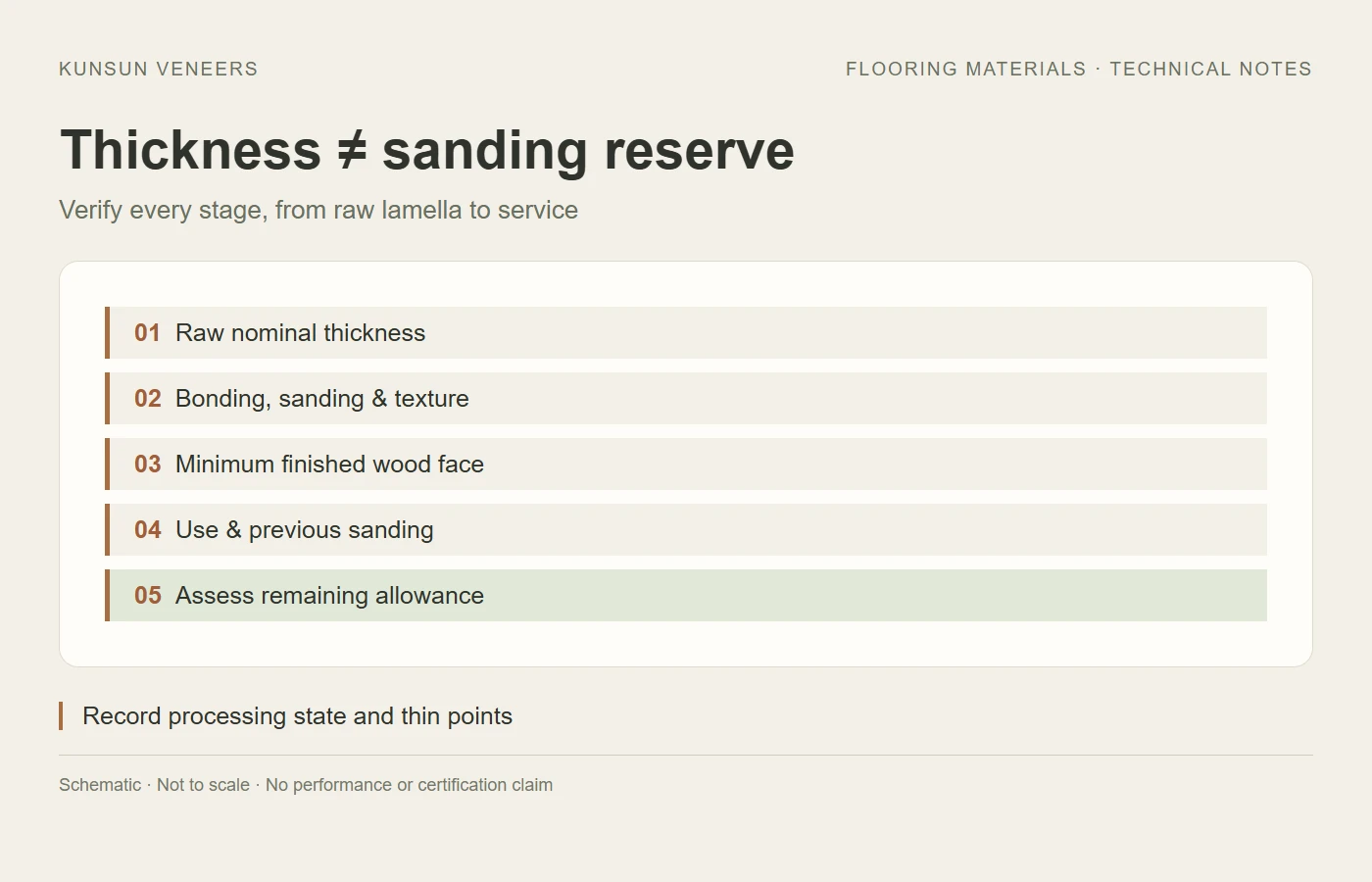
Full refinishing removes the old surface and sands to bare wood before recolouring or finishing. Recoating may treat only the coating. Unevenness, deep damage, brushing and sculpted surfaces can increase removal or change the original appearance.[2] The 2023 NWFA voluntary Refinishable Program sets minimum wood-face thresholds of 3.2 mm for unfinished products and 2.5 mm for factory-finished products; sculpted products require at least 2.5 mm at their lowest point and individual evaluation. These are programme criteria, not worldwide law or evidence that KUNSUN products are certified.[3] NWFA technical guidance generally advises against sanding when the existing wear layer is below about 2.5 mm. This is an assessment threshold, not an amount to remove each time. A professional must consider remaining wood, joints, flatness, previous sanding and manufacturer instructions. Do not calculate sanding cycles by dividing nominal thickness by a fixed removal figure.[2]
5. Underfloor heating: assess the installed system
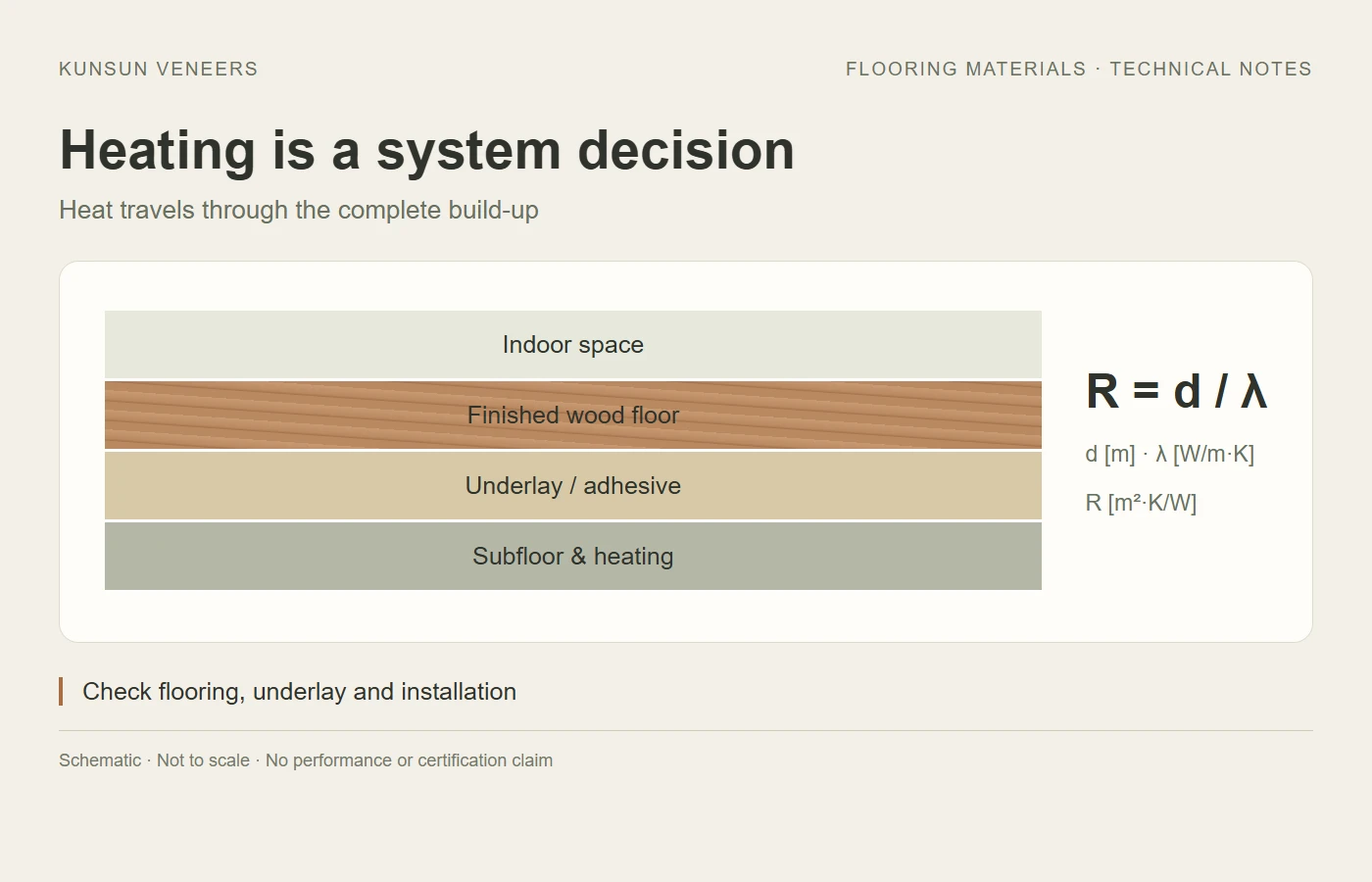
For a one-dimensional steady-state approximation, a material layer has R = d / λ, where d is thickness in metres, λ is thermal conductivity in W/m·K, and R is in m²·K/W. A layered build-up requires considering the floor and underlay; contact and installation affect real heat transfer.[4] Increasing thickness of the same material generally increases resistance. A thin face alone does not establish suitability: core, total thickness, underlay, fixing method, moisture condition, operating climate and commissioning all matter. Kährs specifies a maximum floor-surface temperature of 27°C for its wood floors and recommends low-resistance underlay. This is a manufacturer example, not a universal temperature standard. Meet the requirements of the specified flooring, adhesive and heating system together.[5]
6. Procurement and acceptance checklist
| Item | Evidence or agreement to request |
|---|---|
| Species and appearance | Species, cut, colour/defect reference samples and written grade definitions |
| Thickness and size | Raw or finished state, tolerances, measuring points, width/length and machining allowance |
| Moisture condition | Requirements for the destination and process, sampling and storage conditions |
| Bonding and construction | Core, backing, bonding process and test reports required by the target market |
| Maintenance and renewal | Remaining finished face and documented maintenance/refinishing conditions |
| Heating and installation | Model-specific approval, system thermal resistance, climate and installation procedure |
Match raw-material moisture and bonding to the actual production process and destination. Do not impose one worldwide moisture figure without validation. Finished-floor installation also requires subfloor moisture assessment and manufacturer compliance.[6]
7. Frequently asked questions
Is a 3 mm face always more abrasion resistant than 1.5 mm?
No. More thickness first means more initial wood reserve. Coating abrasion, indentation and repairability are separate properties.
Can a 3 mm lamella guarantee two sandings?
No. Finished thickness, thin points, floor flatness and actual removal can change the outcome.[2]
Is a multi-ply floor never suitable for full sanding?
That is not a valid general rule. Evaluate the actual product and remaining wood, rather than layer count.[1][2]
Must heating floors have a 1.2–1.5 mm face?
There is no such universal rule across constructions. Obtain model-specific heating approval, thermal data and installation conditions.[4][5]
What should a lamella buyer clarify first?
Establish whether the quoted thickness is raw or finished, agree the target after processing and its tolerance, then specify species, size, moisture, bonding and maintenance goals.
Related flooring top layers and technical reading
These are component and technical references, not guarantees of finished-floor refinishing or heating compatibility.
References
- NWFA — Installation Guidelines
- NWFA / Hardwood Floors — Refinish Your Floor
- NWFA — Refinishable Program (2023)
- Junckers — Underfloor Heating, E 4.0
- Kährs — Flooring FAQ
- NWFA — Problem Prevention
Reviewed 2026-11-10. General selection guidance. Diagrams are not to scale and do not establish product testing or certification.