
Foreign Trade Basics: How to Read Shipping Container Markings
The short answer
Container-door markings identify the equipment, its size and type, its rated mass limits and volume, and its safety and sealing information. 45G1 normally describes a 40-foot, 9-foot-6-inch-high general-purpose container—not a 45-foot container. [1]
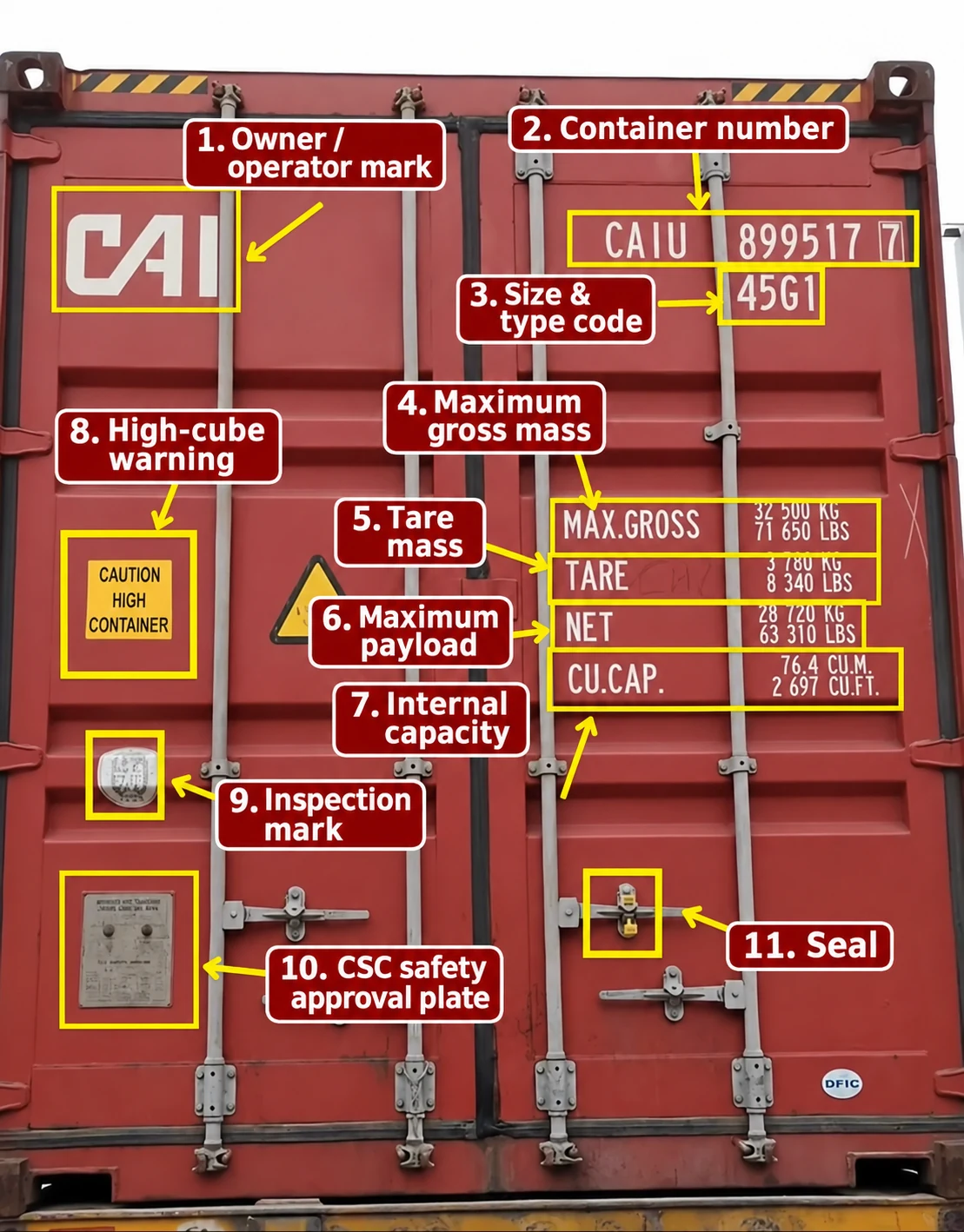
The supplied photograph is a teaching reference. Its maximum gross mass is a rating, and NET is maximum payload, not the net weight of this shipment. The small inspection mark and seal details are indistinct; neither current approval nor a compliant seal can be established from this image alone.
Eleven markings at a glance
| No. | Marking | Meaning and practical check |
|---|---|---|
| 1 | Owner / operator mark | A commercial identification clue; not necessarily this shipment’s ocean carrier |
| 2 | CAIU 899517 7 | Three-letter owner code, equipment category, six-digit serial number and check digit |
| 3 | 45G1 | Size/type code for a 40-foot high-cube general-purpose container |
| 4 | MAX. GROSS 32,500 KG | Maximum permitted combined mass of the container and everything loaded inside |
| 5 | TARE 3,780 KG | Empty-container mass shown in this photo; read the actual unit |
| 6 | NET 28,720 KG | Rated maximum payload, including cargo and packing/securing materials |
| 7 | CU. CAP. 76.4 CU.M. | Nominal internal volume, not guaranteed usable cargo volume |
| 8 | CAUTION HIGH CONTAINER | High-cube warning; check total vehicle height and route clearance |
| 9 | Inspection mark | Verify its issuer and status on the actual equipment |
| 10 | CSC safety approval plate | Safety approval and examination information; not a cargo quality certificate |
| 11 | Seal position | Check the seal, number and integrity; the photo does not prove compliant sealing |
1–2: Owner mark versus container number
A large logo may indicate an owner or operator, including a leasing company. It does not establish the carrying line, voyage or contractual responsibility. In the ISO identification number, the first three capital letters identify the registered owner or principal operator. The fourth character U identifies a freight container. Read CAIU as CAI + U; all four characters are not the company code. The next six digits, 899517, are the serial number; the final 7 is the check digit. [2]
The check digit helps detect recording and transmission errors. It cannot establish ownership authenticity, condition, cargo contents or seal integrity. Compare the full number, character by character, with the equipment interchange record and shipping documents.
3: Why 45G1 means a 40-foot high cube
The first character 4 means 40 feet in length. The second character 5 indicates a height of 9 feet 6 inches at standard width. G1 denotes a general-purpose container with passive vents at the upper part of the cargo space. The high-cube property comes from the size code, not G1 alone. [1]
Common comparisons are 22G1 for a 20-foot standard-height general-purpose unit, 42G1 for a 40-foot standard-height unit, 45G1 for a 40-foot high cube and L5G1 for a 45-foot high cube. Do not read the first two characters together as a length. External dimensions are also different from internal dimensions and door openings; confirm the actual equipment specification before planning long packages or pallets.
4–6: Gross rating, tare and maximum payload
The kilogram values visible in the photograph are 32,500 kg maximum gross mass, 3,780 kg tare and 28,720 kg maximum payload. They reconcile: 32,500 − 3,780 = 28,720 kg. The 3,860 kg and 28,120 kg examples in the other supplied reference image should not be applied to this unit.
Payload includes cargo, packaging, pallets, dunnage, securing materials and other items packed inside. It is not the same as merchandise net weight or the actual shipment’s packed gross weight. The CTU Code explains the relationship between gross rating, tare and available payload. [3]
The container’s rating is not a route-wide transport allowance. Road axle limits, vehicle combinations, rail, terminal, carrier and booking restrictions may be lower. Weight distribution, floor point loads and securing remain essential even when total mass is below the rating.
Actual packed mass and VGM
MAX. GROSS is a maximum rating. VGM is the verified actual gross mass of the packed container. Under applicable SOLAS requirements, the shipper must provide VGM before loading on the ship: either weigh the packed unit, or use a certified method approved by the competent authority where packing took place to total cargo, packaging, pallets, dunnage and securing materials and add container tare. The required VGM must be obtained and communicated before ship loading. [4]
If all loaded items actually total 20,000 kg and verified tare is 3,780 kg, the calculated total is 23,780 kg. It can be submitted as VGM only through the applicable certified and reporting process. Do not declare the 32,500 kg rating as actual VGM.
7–8: Capacity and the high-cube warning
CU. CAP. or CUB. CAP. is internal capacity; CU.M. means cubic metres and CU.FT. cubic feet. The photo gives 76.4 m³, approximately 2,697 ft³. Doors, pallet layout, non-stackable packages, handling clearance and moisture-control arrangements can all reduce usable space. Volume alone does not confirm a loading plan. [5]
A typical high cube is 9 feet 6 inches externally, approximately 2.896 m, compared with 8 feet 6 inches, approximately 2.591 m, for a common standard-height container. Road clearance must be checked against the loaded vehicle’s overall height including its chassis, not the container alone.
9–10: Inspection marks and the CSC plate
An inspection or classification mark can be a useful verification clue, but the photograph is not clear enough to identify the issuer of item 9 or confirm its validity. Item 10 is normally the CSC safety approval plate, sometimes incorporated into a combined data plate. CSC means the International Convention for Safe Containers; it is not an ISO cargo-quality certification. [5][6]
Check approval details, manufacture date, maximum operating gross mass, allowable stacking load and transverse racking test data, together with the applicable next examination date or Approved Continuous Examination Programme (ACEP) marking. A plate does not establish current physical condition. Inspect locks, structural damage, water ingress, cleanliness and odours. CSC does not certify cargo compliance with phytosanitary, food or dangerous-goods requirements. [6][7]
11: A seal provides evidence, not an absolute guarantee
Modern container seals may be high-security bolt seals; they need not contain lead. The seal number is separate from the container number. A seal provides evidence of tampering, not proof that the unit has never been opened or that cargo quantities are correct.
Apply seals according to destination, carrier and applicable security-program requirements. Where high-security seals are required, verify ISO 17712 conformity. Record container number, seal number, sealing time and photographs, and reconcile the documents. If customs replaces a seal after inspection, retain the authorized examination record and both old and new numbers. Preserve evidence and follow handover procedures if a number differs or tampering is suspected. [8]
Loading checklist for veneer and timber shipments
- Match the full container number and size/type; confirm door and internal clearances for pallets and long packages.
- Inspect for moisture, dirt, odour, visible damage and water-entry risks; retain photographs.
- Reconcile actual tare, cargo and all packing/securing materials with equipment and route limits.
- Plan support, movement restraint and moisture protection for veneer; capacity alone does not establish suitability.
- Submit applicable VGM, verify seals and retain loading/handover records. Check wood-packaging phytosanitary requirements separately; CSC does not replace them.
Frequently asked questions
Is 45G1 a 45-foot container?
No. It normally describes a 40-foot high cube: 4 indicates length and 5 height. [1]
Can NET be copied into a packing list as cargo net weight?
No. Door NET is rated payload. Packing lists require the actual shipment’s relevant net and gross weights.
Does a CSC plate alone make a container ready to ship?
No. Examination status, actual condition, applicable VGM and carrier requirements also need checking.
Which number identifies the equipment?
The container number identifies the unit. The seal number identifies the applied seal; replacements need a traceable record.
Related reading
Confirm the actual equipment, cargo packaging and transport route before loading.
References
- BIC — Size and type codes
- BIC — Container identification number
- UNECE CTU Code — Maximum gross mass
- IMO — Verification of gross mass
- BIC — Container markings
- IMO — International Convention for Safe Containers
- US Coast Guard — ACEP
- CBSA — How to use cargo seals
- BIC — Detailed type codes
- Hapag-Lloyd — Container specifications
Chinese reference image retained as supplied. Other editions use AI-assisted localized annotations and are educational illustrations, not equipment inspection or handover evidence. Verify actual markings and transport records.