
Seven Common Pallet Types for Import, Export and Container Shipping
Choosing a pallet for a container shipment involves more than wood versus plastic. Manufacturing process, supports, deck design, entry direction and handling equipment all affect loading and reuse. This illustrated guide explains seven familiar names and the details to confirm before specifying a pallet.
These are overlapping descriptions, not seven exclusive classes or a popularity ranking. Rotational and injection molding describe processes; block and stringer describe supports; double-face, double-wing and solid-deck describe decks or shape. A single pallet can combine several features.
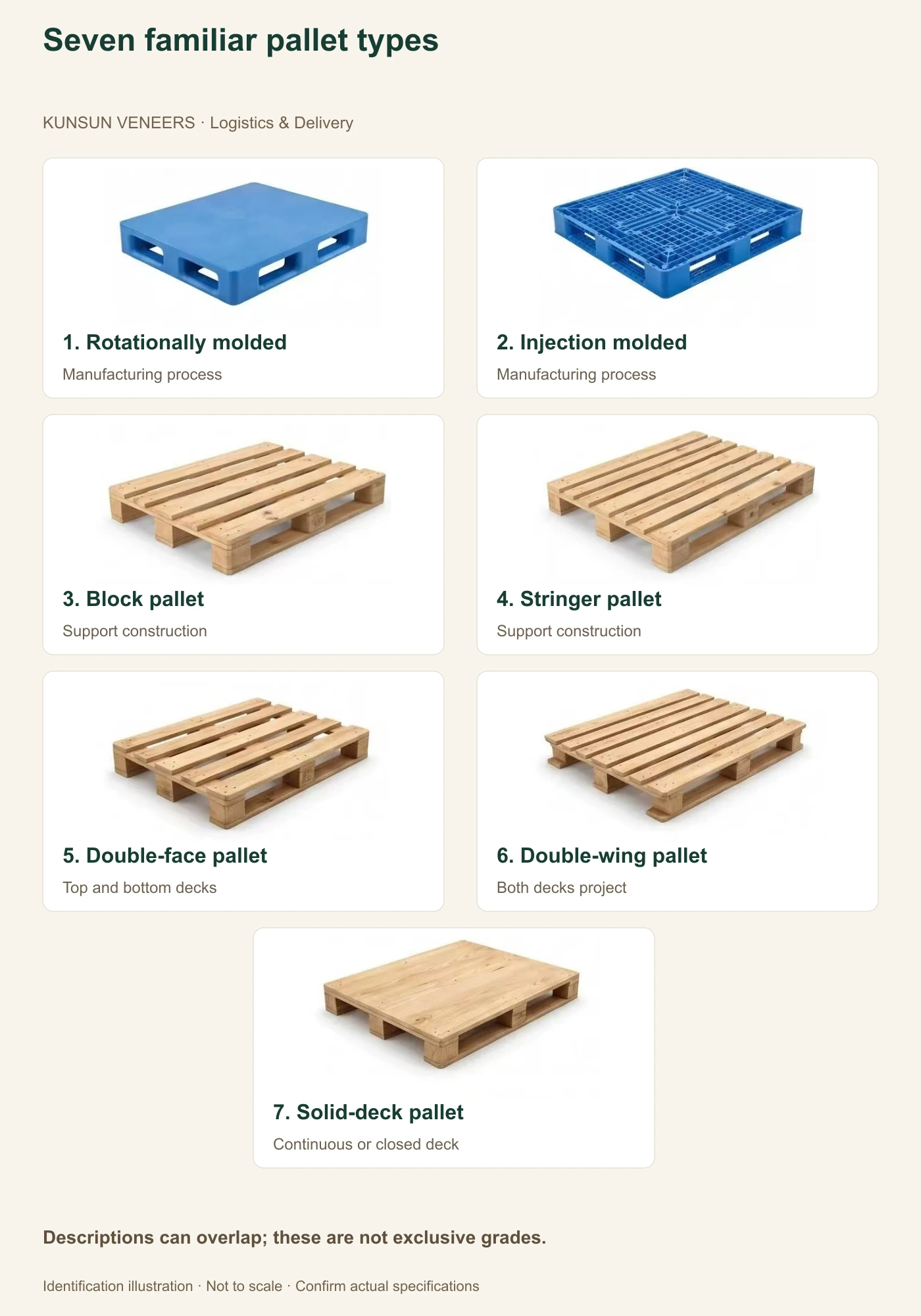
1. Rotationally molded plastic pallets
Rotational molding can suit large plastic pallets with relatively simple designs. Reinforcement options, cleaning and load limits depend on the model. Compare tooling, order quantity, service life and return logistics when assessing cost; the process alone does not prove a lower price.[3]
Selection check:For food or pharmaceutical projects, verify material suitability, cleaning validation and customer requirements. The process name is not a hygiene certification.
2. Injection molded pallets, including HDPE
Injection molding supports repeatable production. HDPE, or high-density polyethylene, is one common material, alongside other resin options. Decks may be open or closed; entry depends on design. Washing, chemical resistance and recyclability depend on resin, exposure, temperature and local collection arrangements.[3][4]
Selection check:For warehouse and returnable systems, check openings, bottom supports and compatibility with forklifts, pallet jacks and automation.
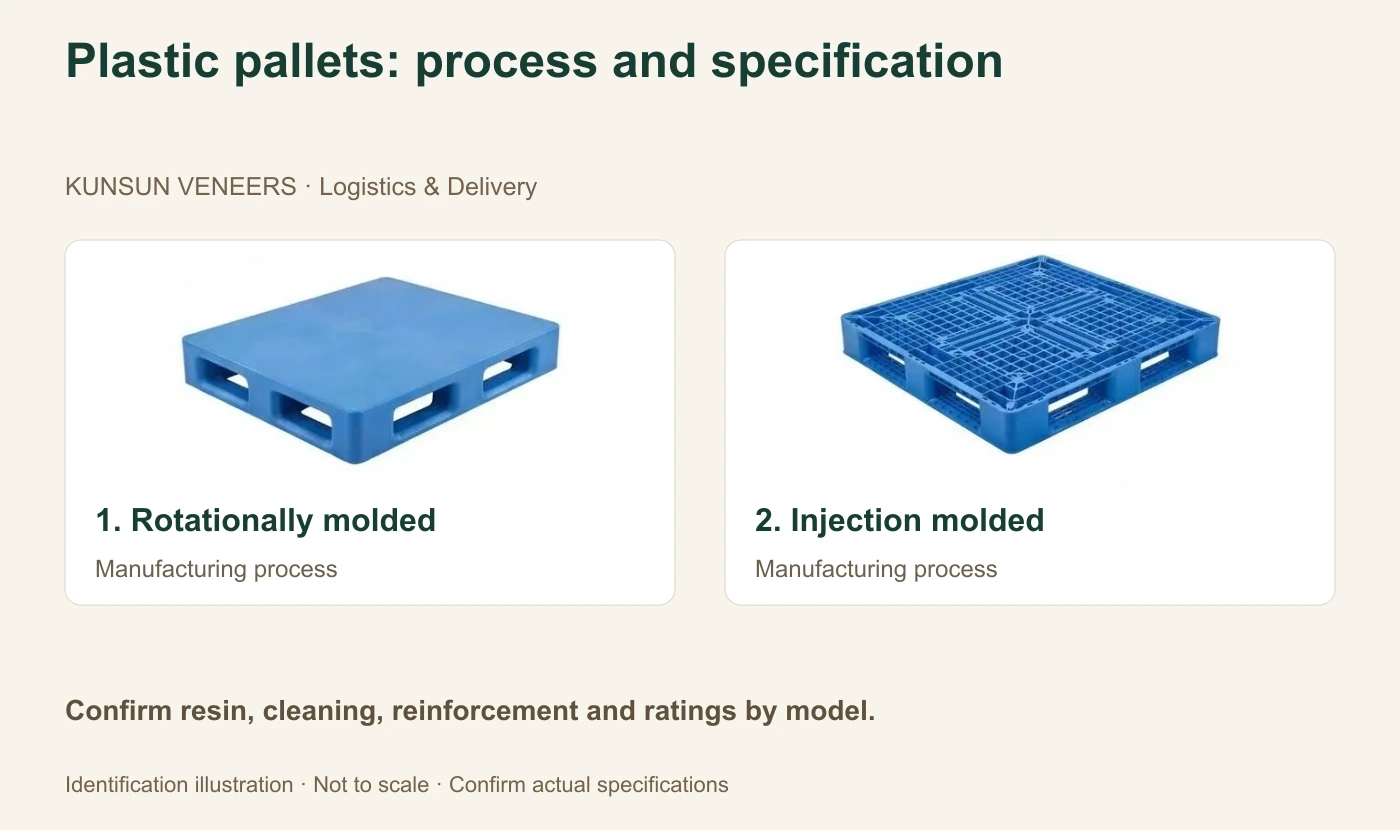
3. Block pallets: commonly four-way entry
Blocks connect the upper deck to the lower structure. This commonly enables four-way entry, but block count, bottom boards and clearances vary. A block pallet is not defined by twelve posts, and a deck-board construction is not a synonym for block construction. Bottom boards can limit some equipment access.[1]
Selection check:Confirm usable openings in every direction and distinguish forklift access from pallet-jack access.
4. Stringer pallets: two-way unless designed otherwise
Continuous stringers support the deck. Conventional unnotched designs normally allow entry at the two ends. Notches can provide side access for forklifts, without necessarily allowing four-way pallet-jack access. Strength depends on materials, member sizes, connections and service conditions; stringers are not automatically stronger than blocks.[1][2]
Selection check:Useful shorthand: blocks commonly allow four-way entry; unnotched stringers commonly allow two-way entry. Always check notches, bottom boards and equipment.
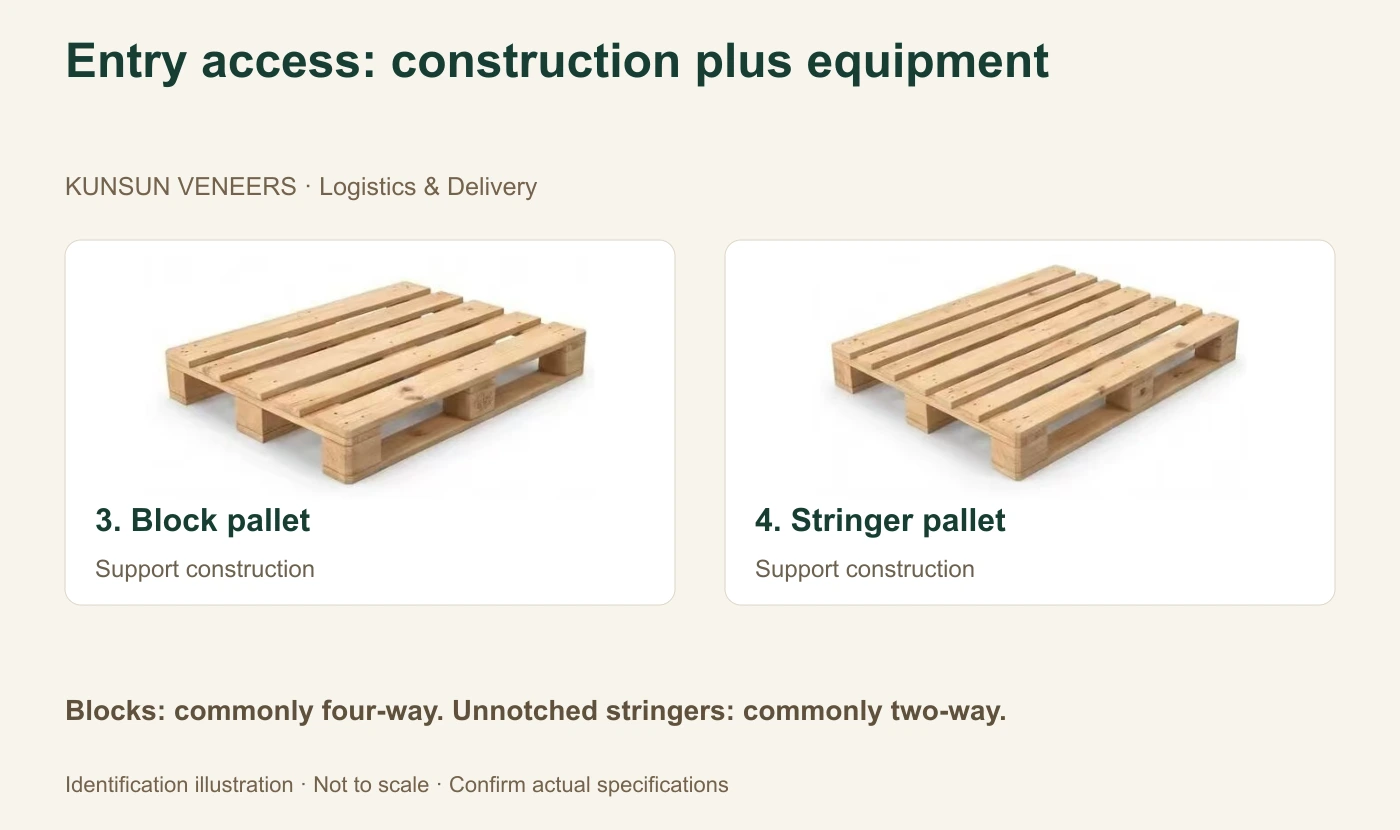
5. Double-face pallets: not always reversible
A double-face pallet has both top and bottom decks. It may be reversible or nonreversible. Only a design confirmed as reversible allows either face to serve as the load-carrying surface. A bottom deck alone does not establish capacity.[1][2]
Selection check:Specify reversibility explicitly and check the bottom deck against handling and rack arrangements.
6. Double-wing pallets: projecting decks
Double-wing describes top and bottom decks extending beyond the stringers or supports. It does not automatically imply a higher payload, permission for cargo overhang or a one-way shipping design. Reuse and any lifting arrangements require separate confirmation.[2]
Selection check:Check the projecting edges, cargo support and overall dimensions; use the outermost dimensions in the container layout.
7. Solid-deck pallets: continuous or closed top surfaces
A solid or closed deck avoids an open slatted top and can provide more continuous support for small packages. It may use a panel or molded construction, rather than a single solid-wood board. Cleaning, drainage, grip and ventilation depend on the actual design and material.[1][4]
Selection check:Small items still need suitable packaging and restraint. A closed deck does not replace stable unit-load design.
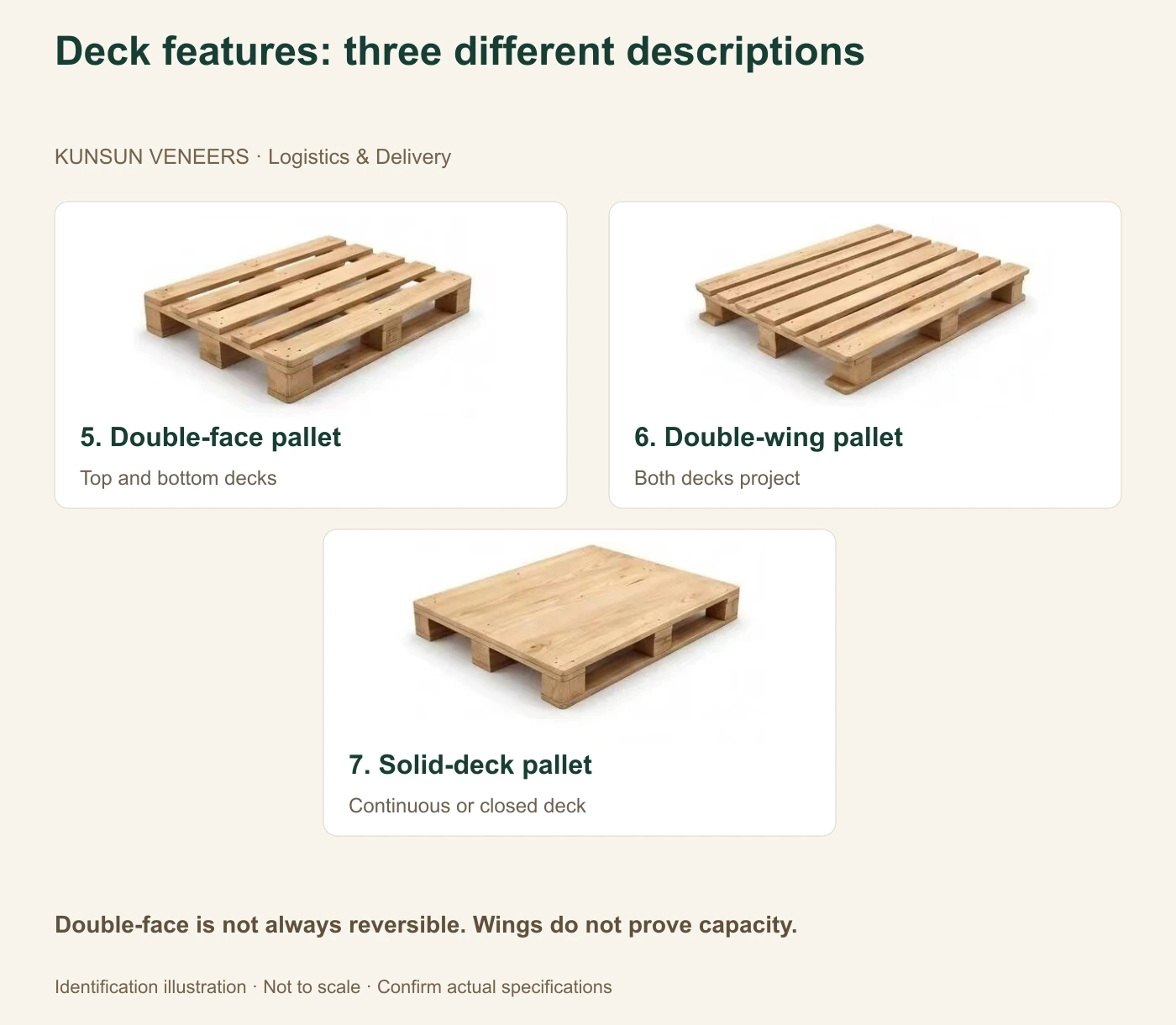
Entry direction: check both construction and equipment
Four visible openings do not prove usable four-way access. Opening height, fork thickness, bottom boards and pallet-jack wheels affect compatibility. Request opening dimensions, approved equipment and access directions, especially for notched stringers.
| Rotationally molded | Manufacturing process |
|---|---|
| Injection molded | Manufacturing process |
| Block pallet | Support construction |
| Stringer pallet | Support construction |
| Double-face pallet | Top and bottom decks |
| Double-wing pallet | Both decks project |
| Solid-deck pallet | Continuous or closed deck |
Before loading a container
- Dimensions: plan with the actual container interior, door opening and pallet envelope instead of a universal pallets-per-container number.
- Load cases: distinguish static, dynamic and racking ratings, including test and support conditions.
- Container limits: verify unit gross weight, centre of gravity, payload and floor or concentrated-load limits; distribute weight appropriately.
- Equipment: confirm forklifts, pallet jacks, racks and conveyor compatibility.
- Restraint: agree suitable blocking, dunnage, lashing or other securing measures; stretch wrap alone does not resolve overhang or loading gaps.
- Wood packaging: check destination ISPM 15 treatment and marking requirements for regulated solid wood. Wholly processed-wood packaging and mixed construction with raw-wood components require different assessment.[5]
Frequently asked questions
Are these seven exclusive pallet categories?
No. One pallet can be plastic, injection molded, double-face, closed-deck and four-way-entry at the same time. Specify each feature separately.
Can every double-face pallet be turned over for loading?
No. Double-face means two decks. Reversibility must be confirmed separately.
Is a two-tonne capacity enough information?
No. Identify static, dynamic or racking use, support conditions and load distribution.
Does every wooden pallet need a fumigation certificate?
Do not assume that. Check the destination requirements for treatment and marking. ISPM 15 provides specified treatment options and does not mean every wood package must be fumigated.
References
- NWPCA — Uniform Standard for Wood Pallets, §4: classification, entry and deck styles
- USDA Forest Products Laboratory — Unitizing Goods on Pallets and Slipsheets
- TranPak — Plastic molding processes
- Craemer — Plastic pallets and application-specific designs
- IPPC — ISPM 15 implementation and wood packaging guidance
Pallet images are adapted from user-supplied reference material for structural identification. They do not represent Kunsun stock models, dimensions, certifications or load ratings. Confirm project-specific packaging specifications.