
North American Red Oak vs White Oak: Properties and Uses
Red and white oak share many interior uses. White oak heartwood advantages do not make it better for every project. Define product form, environment and construction before appearance and cost.
Values refer to representative species. Graphics are educational summaries, not stock photographs or product certification.
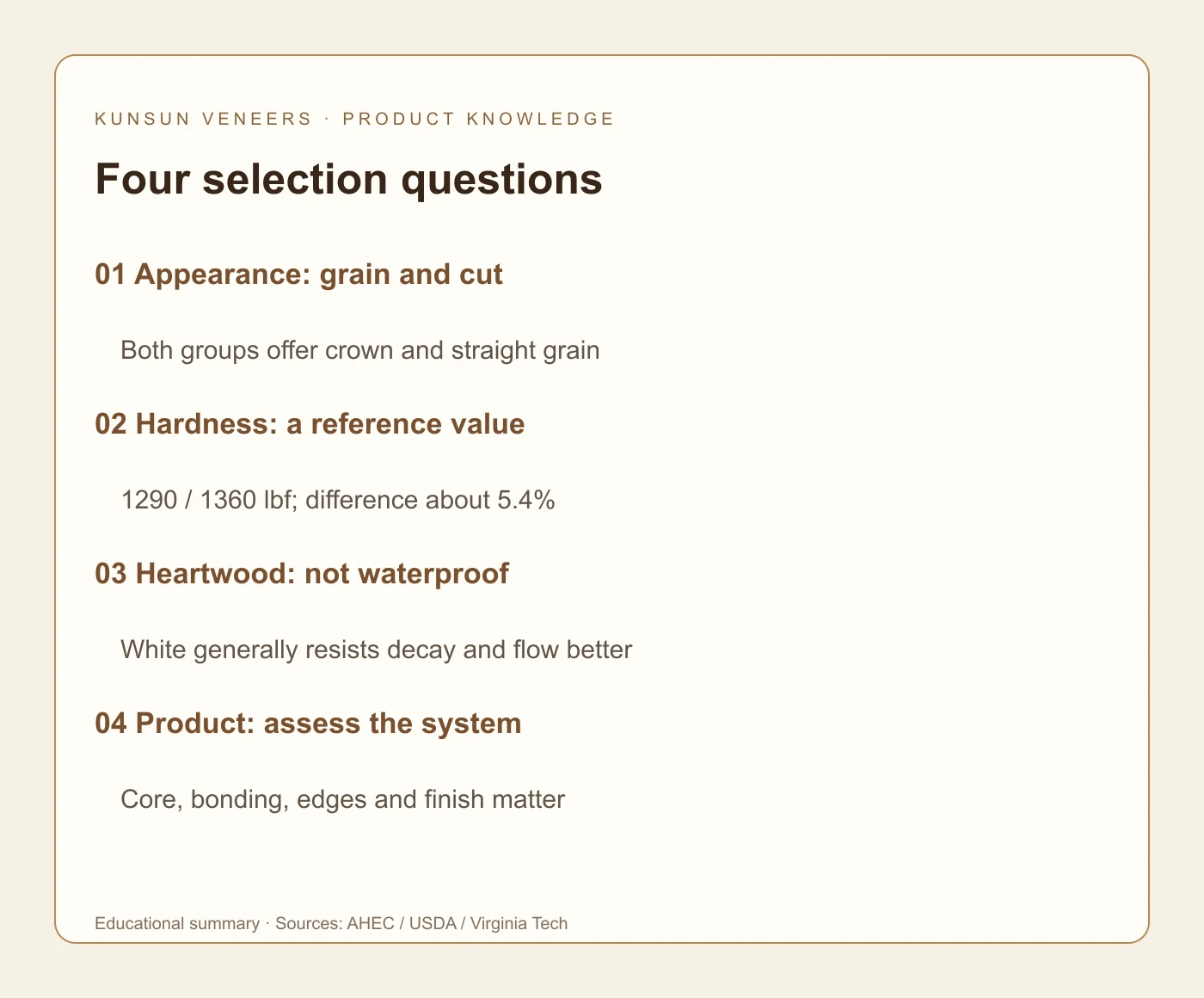
Two commercial oak groups
Red and white oak are familiar North American hardwood groups containing several species. Northern red oak, Quercus rubra, and American white oak, Quercus alba, are useful reference species, not guaranteed identities for every shipment. The eastern United States is an important source of both. [1][2]
Selection tip:Confirm against batch samples and service requirements.
Colour, grain and cutting direction
Red oak heartwood often has pink or reddish-brown tones; white oak commonly shows light to medium brown. Colours overlap and finishing changes appearance. Both are ring-porous; white oak generally has longer rays with prominent figure on radial faces. Crown grain, straight grain and ray fleck also depend on the cut, not just the group name. [1][2][4]
Selection tip:Confirm against batch samples and service requirements.
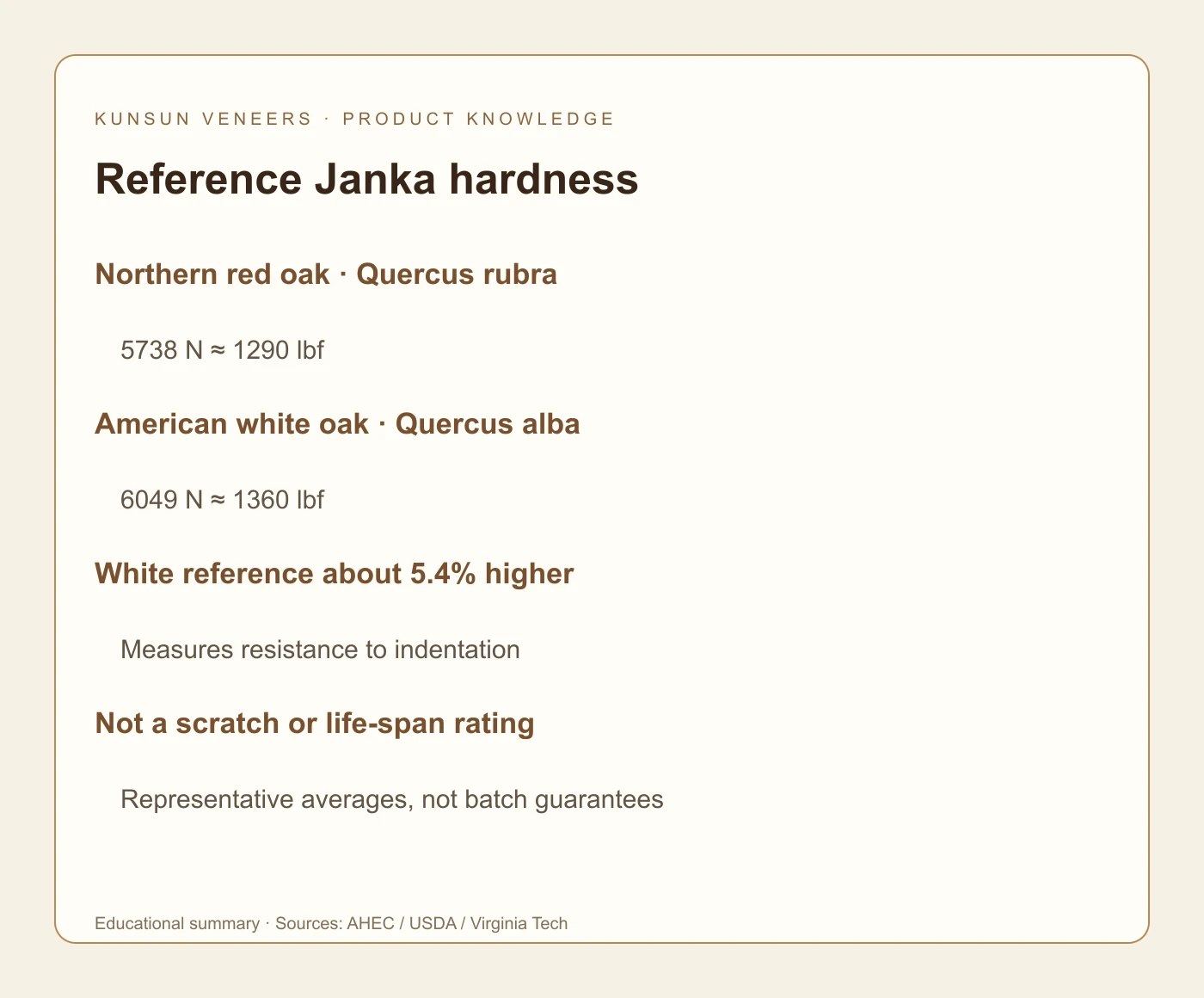
Janka hardness: a modest difference
Common reference values are 5738 N (about 1290 lbf) for northern red oak and 6049 N (about 1360 lbf) for American white oak: roughly 5.4% higher for white oak. Janka measures indentation resistance, not scratching, finish wear, bending strength or life span. These representative averages vary with species, moisture and test conditions; they are not batch guarantees. [1][2][5]
Selection tip:Confirm against batch samples and service requirements.
Permeability and decay concern heartwood
Tyloses commonly obstruct white oak heartwood vessels, restricting liquid flow along them and supporting selected white oak for tight cooperage. Red oak is generally not a direct substitute. White oak heartwood usually has better natural decay resistance. Permeability and decay are separate properties; neither makes a product waterproof. Do not extend heartwood advantages to sapwood, every white oak species or any finished product. [3][4]
Selection tip:Confirm against batch samples and service requirements.
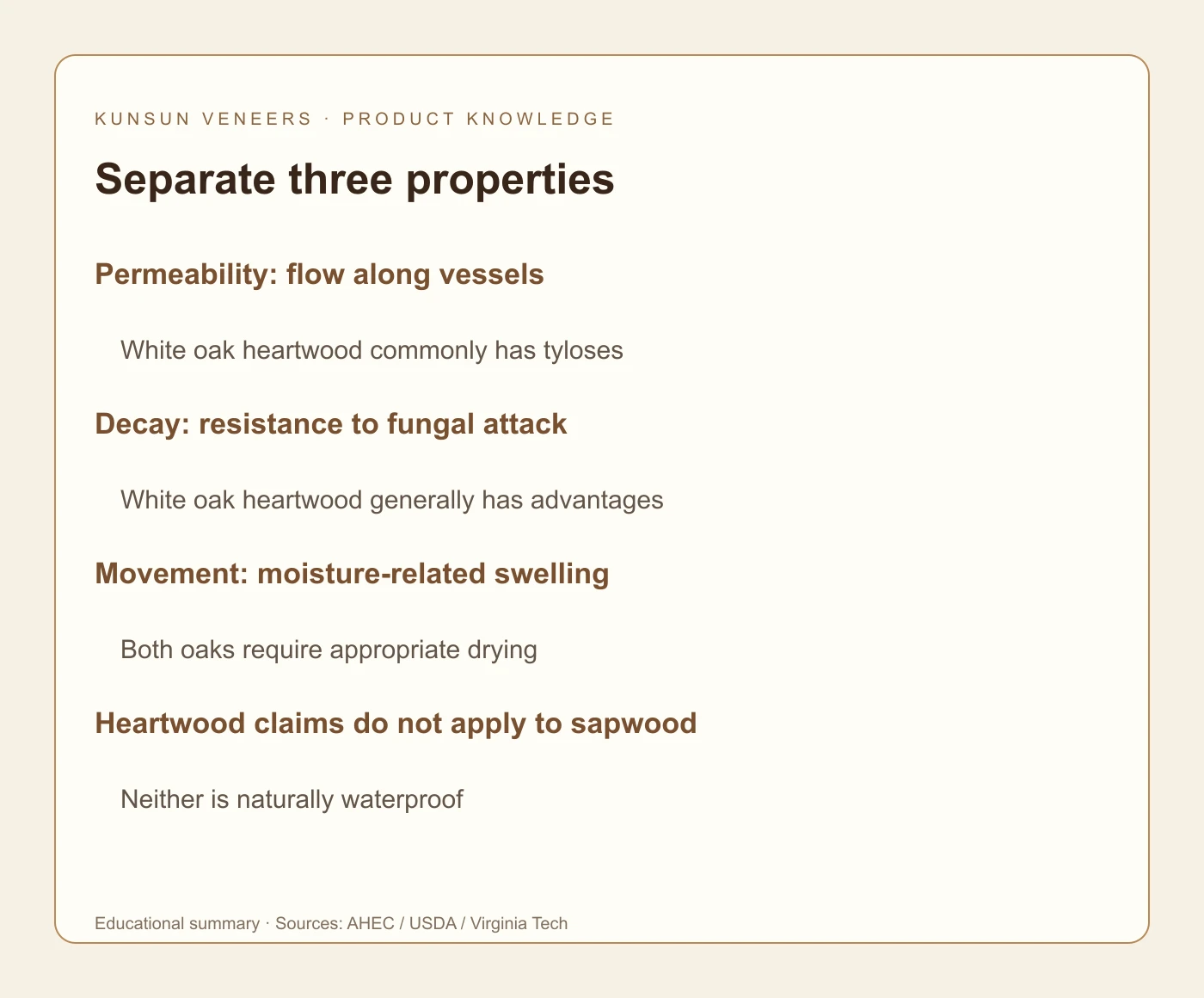
Movement: both need proper drying
Tyloses do not stop moisture exchange. Both shrink and swell as moisture content changes, with different radial and tangential movement. Decay resistance does not prove white oak is always more stable. Cut, width, drying quality, humidity and construction matter. Condition material for service and provide movement allowances and drainage. [1][2][3]
Selection tip:Confirm against batch samples and service requirements.
Machining, staining and finishing
Both groups can be machined, glued and finished. Open pores may need grain filling for a smooth closed-pore finish; white oak is not pore-free. Consider pilot holes for fasteners. Staining depends on sanding, sealers, stain chemistry and the individual wood; red oak is not universally easier to colour. Test the complete process on the supplied batch. [1][2]
Selection tip:Confirm against batch samples and service requirements.
Shared interiors and specialised uses
Both serve furniture, flooring, cabinets, doors, mouldings and decorative veneer. Select dry-interior material by figure, colour and budget. White oak heartwood has a stronger basis for specialised decay-resistant or liquid-tight uses. Bathroom furniture still needs splash protection and maintenance; exterior work requires assessment of sapwood, joints, end grain, finish and exposure. A species name does not approve any board for damp or outdoor use. [1][2][3]
Selection tip:Confirm against batch samples and service requirements.
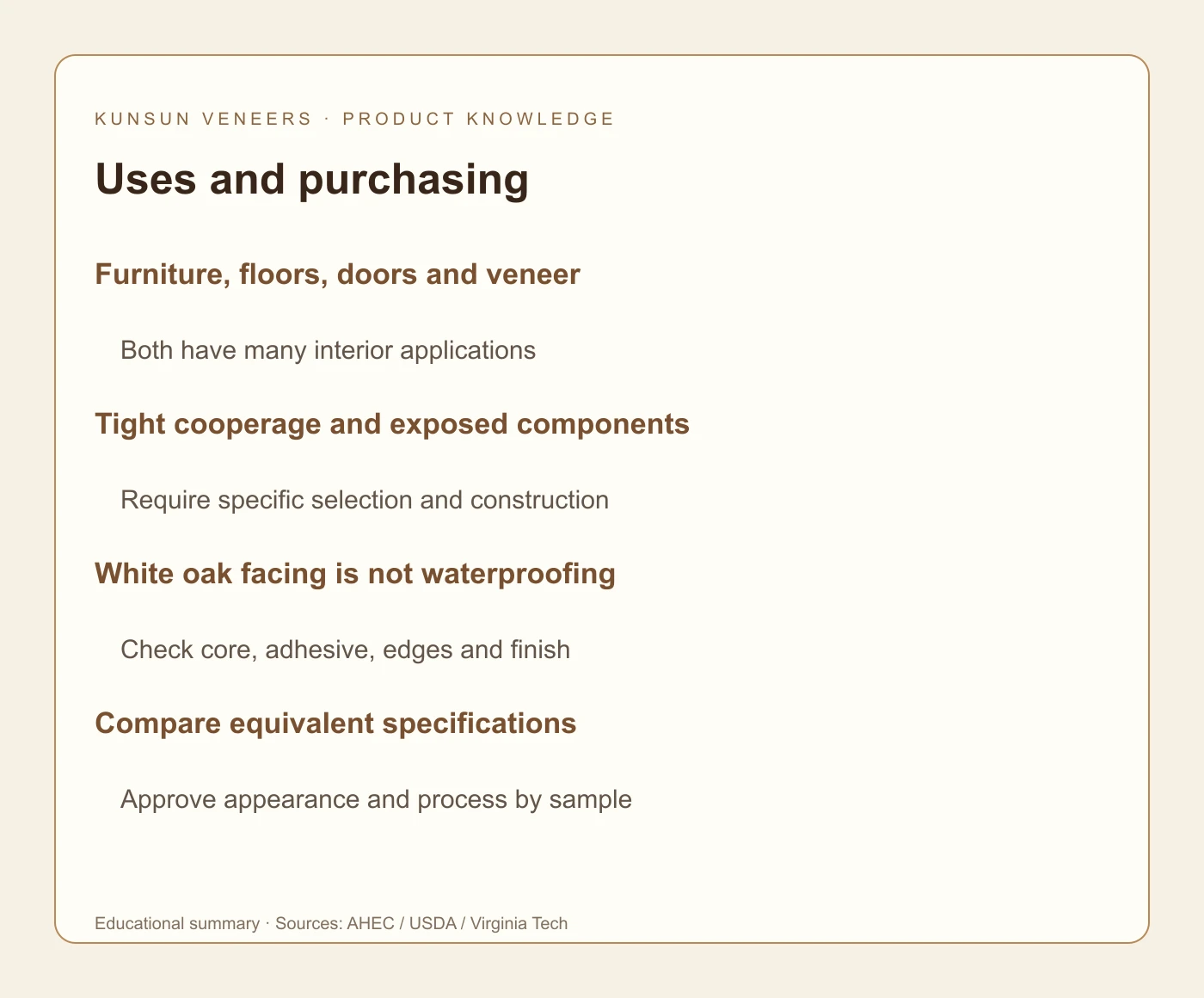
Veneer and panels: assess the whole system
Decorative veneer supplies appearance. Panel moisture performance and flatness also depend on core, adhesive, balance, pressing, edge sealing and finish. White oak facing does not make MDF or plywood waterproof. Solid-wood Janka data is not a finished-panel test. Compare quotations on equal thickness, grade, cut, quantity and delivery terms, not a presumed fixed premium.
Selection tip:Confirm against batch samples and service requirements.
Quick comparison
Values refer to representative species. Graphics are educational summaries, not stock photographs or product certification.
| Reference hardness | Red 5738 N; white 6049 N |
|---|---|
| Heartwood | White generally resists decay and liquid flow better; not waterproof |
| Movement | Both respond to moisture changes |
| Veneered panels | Assess core, bonding, edges and finish |
Before ordering
- Confirm species, region and grade.
- Specify thickness, dimensions, cut, matching and core.
- Agree moisture content, measurement and service conditions.
- Approve figure, colour, knots and finish by sample.
- Compare like-for-like quotations and delivery terms.
Common questions
Is white oak always better?
No. Select by environment, construction, appearance and budget.
Does white oak facing make a panel waterproof?
No. Assess the complete material system.
Technical sources
- AHEC — Red oak
- AHEC — White oak
- USDA — Wood Handbook
- Virginia Tech — Wood identification
- American Hardwood Information Center — Types of Wood
Checked 2026-10-29. Reference values do not replace batch tests or engineering design.