
Board Emission Grades in One Minute: ENF, E0 and E1
ENF, E0 and E1 classify formaldehyde emissions from wood-based panels and their products. They are not comprehensive environmental ratings. Under the specified test conditions, their limits are 0.025, 0.050 and 0.124 mg/m³ respectively. ENF has the strictest limit of these three grades.
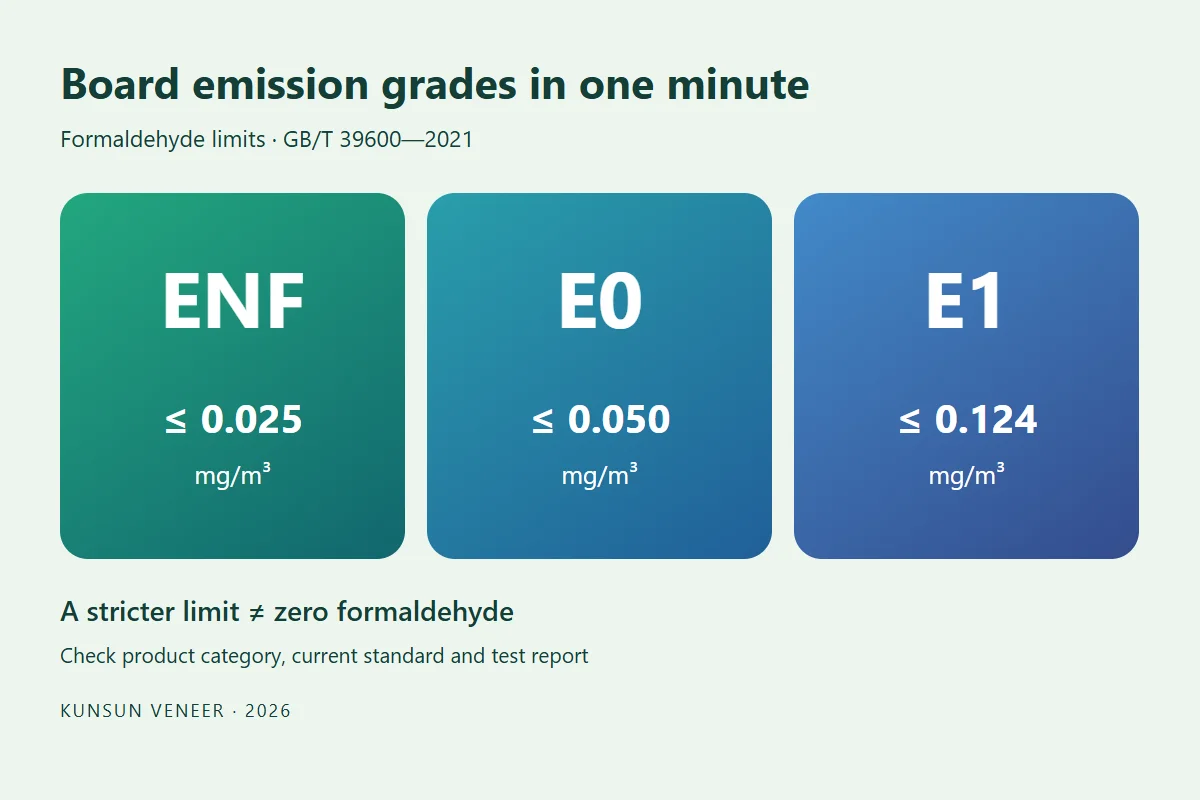
Three grades at a glance
| Grade | Formaldehyde emission limit | Meaning |
|---|---|---|
| ENF | ≤0.025 mg/m³ | Strictest of the three; does not mean zero formaldehyde |
| E0 | ≤0.050 mg/m³ | Lower limit than E1; check the applicable mandatory product requirements |
| E1 | ≤0.124 mg/m³ | Not a universal current entry requirement for every interior panel product |
These grades come from GB/T 39600-2021. They describe material emissions under specified laboratory conditions, not the formaldehyde concentration in an occupied room. [1]
What changed in 2026?
GB 18580-2025 took effect on 1 June 2026, replacing GB 18580-2017. It distinguishes wood-based panels, with a limit of ≤0.124 mg/m³ and E1 marking, from wood-based panel products, with a limit of ≤0.050 mg/m³ and E0 marking. Determine the actual product category and applicable standard before judging compliance; an advertising label alone is insufficient. [2] [3]
Four practical purchasing checks
- Match the test report to the purchase. Check the standard, test method, product name, model, thickness, sampled material, measured result and conclusion.
- Consider the total material load. Cabinets, wall panels and flooring can all contribute. A compliant panel does not guarantee compliant room air.
- Assess the complete material system. Include the substrate, facing, adhesive and finish. Natural veneer species or appearance cannot replace a test report for the finished panel.
- Combine material selection with ventilation and acceptance checks. For tighter emission control, compare products supported by relevant ENF test evidence, control material quantities and verify indoor air under applicable requirements.
Frequently asked questions
Does ENF mean zero formaldehyde?
No. It means a limit of 0.025 mg/m³ under the prescribed test conditions. It is not proof of zero formaldehyde or absolute safety.
Does a stricter grade always cost more?
No. Panel type, structure, dimensions, facing, brand and supply conditions also affect price. Price alone cannot establish emission performance.
Is E1 only for public spaces?
No. Grades are not room-use labels. Evaluate the product category, mandatory requirements, test results and project specifications. ENF is not automatically a maternity or infant safety certification.
Check the grade, the applicable standard, the report and the total material quantity.
Related reading
Distinguish natural veneer, the substrate and the finished veneered panel. Appearance does not establish formaldehyde performance.
References
- GB/T 39600-2021 — Formaldehyde emission grading
- GB 18580-2025 — Official standard record
- National Forestry and Grassland Administration — New emission requirements
Original numerical illustration for this article; not a material test report.