
Common Solid Wood Boards: Properties and Applications
Choose solid wood by species, moisture content, sawing pattern, defect limits and service environment. Oak is widely used for furniture and flooring; ash suits components where toughness matters; black walnut and cherry provide distinctive natural colour; rubberwood and many pines serve indoor furniture applications. Processing, construction and finishing determine how those properties translate into a finished item.
This guide concerns indoor furniture and decorative use. Oak, ash and pine trade names can cover several species. Black walnut means Juglans nigra, American cherry means Prunus serotina, and rubberwood means Hevea brasiliensis here. Suggested uses are selection guidance, not certification of a particular shipment.
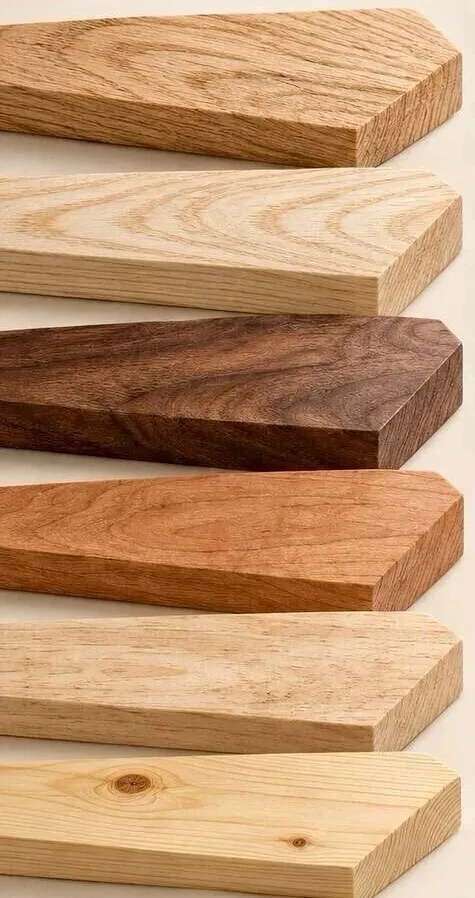
1. Separate species, board construction and surface material
Oak identifies a species group; finger-jointed board describes construction; wood veneer identifies a surface material. Sawn solid wood comes from logs. Edge-glued and finger-jointed boards use bonded solid wood strips and still require control of movement and bond quality.
A veneered panel combines a wood face with a substrate. Load capacity, stability and screw holding belong to the complete system, not to the veneer alone. Flooring lamellas are components of engineered flooring, not finished solid wood flooring. Specify species, construction, face thickness and component location in the contract.
2. Six common woods at a glance
| Wood | Characteristics | Common applications | Selection priorities |
|---|---|---|---|
| Oak | Prominent pores and rays; red and white oak differ | Tabletops, chair frames, doors, flooring | Species, sawing, drying and movement allowance |
| Ash | Pale appearance, distinct growth rings, valued toughness | Chair frames, legs, bent parts, indoor flooring | Grain direction, knots, process and humidity |
| Black walnut | Brown heartwood contrasts with pale sapwood | Desks, tabletops, cabinet doors, veneer | Colour sorting, sapwood allowance and protection |
| Cherry | Fine texture; colour develops with light and time | Chests, bedside furniture, doors, mouldings | Colour matching, trial finishing and dents |
| Rubberwood | Pale wood often supplied glued or finger-jointed | Chairs, table frames, beds, furniture parts | Treatment, drying and bonding records |
| Pine | Many species; often distinct rings, knots and resin | Beds, shelves, drawer sides, interior frames | Species, grade, knots, joints and shelf span |
1. Oak: distinctive grain and broad applications
Oak can display cathedral grain, straight grain and ray figure; sawing direction changes the appearance. It is used for furniture and flooring. Identify red and white oak separately rather than by colour alone. White oak heartwood properties do not make every oak product suitable for damp service.[1]
Wide tops need fixings and end details that accommodate cross-grain movement. Extra thickness or a coating alone cannot guarantee freedom from cracking.
2. Ash: toughness for furniture components
Ash generally has pale tones and clear grain contrast. Chair frames, legs and appropriately processed bent components are typical uses, with toughness and impact resistance among its selection advantages.[2]
Bending also depends on grain, knots, moisture, section size and process trials. Regional trade names do not establish identical species. Ordinary unprotected ash should not be assumed suitable for persistently damp or outdoor locations.
3. Black walnut: natural brown colour and fine work
North American black walnut has light brown to chocolate heartwood and paler sapwood. It is used for desks, tops, cabinet doors and veneer. Sorting, sapwood proportion, steaming and finishing influence colour consistency.[3]
Darker is not automatically a higher grade. Agree natural colour variation separately from defects. Frequently used tops still need protection against dents and scratches. Describe a veneered door by its substrate and face construction rather than as a solid slab.
4. Cherry: fine texture and maturing warm colour
American cherry is used for chests, bedside furniture, doors and mouldings. It machines and finishes well, while its colour changes with time and light; covered areas can age differently from exposed surfaces.[4]
Select coordinated material and trial finish samples for matched furniture. New parts cannot be promised to match older pieces immediately. The hardwood label does not guarantee dent resistance; check stain absorption on the actual batch.
5. Rubberwood: indoor furniture with controlled processing
Rubberwood comes from the rubber tree, not from Quercus oaks. Furniture frames, chairs, beds and glued boards are common applications. Commercial use depends on prompt treatment, suitable drying and dependable processing.[5]
Review treatment records, drying, glue lines and intended use. The name does not imply rubber-like elasticity. Assess preservatives, adhesives, coatings and finished-product requirements individually rather than judging safety from species alone.
6. Pine: specify the species and grade
Pine covers multiple Pinus species with different density, hardness and strength. Furniture pines often show clear rings and knots and can be used for beds, shelving, drawer sides and interior frames.[6]
Check loose knots, splits and resin, especially around connections. Shelf performance also depends on span, thickness, support and sustained load; the pine name or thickness alone cannot establish capacity.
3. Three factors behind finished performance
Match moisture to the destination
Wood exchanges moisture with air and changes dimensions; movement across grain is generally greater than along it. There is no single acceptance value for every climate. Agree targets against destination humidity, heating, air conditioning and component size, and document meter corrections, measuring locations and sampling.[7]
Evaluate hardness, strength and stability separately
Hardness concerns local indentation, strength concerns load resistance, and dimensional stability concerns moisture-related size change. Dark colour does not prove greater hardness, and harder wood is not movement-free.
Design the finish and structure together
Finishes affect feel, stain resistance and the rate of moisture exchange. They do not make indoor boards permanently waterproof. End grain, holes, backs, joints and fixings need a design suited to the application.
4. Select by application
- Dining tops: compare dent resistance, stain protection, repairability and fixing details. Oak and walnut are possible options; colour cannot replace performance assessment.
- Frames and legs: examine grain continuity, joint-zone defects, connection design and finished load testing. Ash, oak and properly processed rubberwood are common candidates.
- Doors and broad decorative faces: compare solid frame construction with veneered panels, including substrate, balancing layer, bonding and edge details.
- Flooring: establish whether the purchase is finished flooring or a top layer. Evaluate wear, coating, installation and climate suitability as a complete system.
- Children’s furniture: also check structure, edges, entrapment risks, hardware and applicable finished-product testing.
5. Purchasing and acceptance checklist
- State the scientific or recognised trade name; distinguish red/white oak and oak/rubberwood.
- Specify sawn, edge-glued, finger-jointed or veneered construction and material locations.
- Agree dimensions, tolerances, moisture range, measurement and sampling.
- Set limits for knots, splits, sapwood, colour, repairs and joints.
- Trial the finish, adhesive and relevant machining with the supplied batch.
- Confirm construction, coating, treatment and applicable documentation for the final use.
Frequently asked questions
Is rubberwood a type of oak?
No. Rubberwood is mainly Hevea brasiliensis; oak normally refers to Quercus species. They must not be interchanged in quotations or contracts.
Does a thicker solid board resist movement better?
Thickness influences stiffness and drying, but movement also depends on species, grain direction, moisture change and restraint. Thickness alone cannot answer the question.
Can veneer replace solid wood?
A veneered construction may suit some decorative applications. Its performance depends on the face, substrate, adhesive and process; solid-board properties cannot simply be transferred to it.
Which wood is best?
There is no best species for every use. Select against application, appearance, process, environment and maintenance, then confirm through samples and acceptance terms.
Related materials and technical reading
Products below are material-selection references, not the furniture shown in the illustration. Veneer, flooring top layers and solid boards are different product forms; confirm specifications and processing with samples.
References
- AHEC — American white oak
- AHEC — American ash
- AHEC — American walnut
- AHEC — American cherry
- FRIM — Rubberwood, Timber Technology Bulletin 14
- USDA Forest Products Laboratory — Wood Handbook
- USDA — Drying and Control of Moisture Content and Dimensional Changes
Sources explain general wood properties and processing; they are not test reports for a Kunsun shipment. Confirmed specifications, samples and contracts govern delivery.